Note that if you purchase something via one of our links, including Amazon, we may earn a small commission.
Using dead wood, bioreceptive concrete, and more, the sculptor uses their art to repair ecosystems and encourage viewers to consider how humans and nature can live in harmony.
“Works in Progress” highlights artists across a range of disciplines whose work deals with ecological themes. Considering the particular role that artists play in the climate movement, this column will share their voices and provide a glimpse behind the curtain into their creative processes and experiences. Through a combination of Q&As and narrative pieces, this column will discuss the relationship between the natural world, advocacy, and the art itself.
Growing up outside of Acadia National Park in Bar Harbor, Maine, Bobby Haskell often took the environment for granted. It wasn’t until they started to see the area around them being developed, and saw how urbanization was contributing to species loss, that they began to appreciate the natural world and the role humans play in it.
While training in sculpture at the University of the Arts in Philadelphia, Haskell started seeking ways to use their artistry to repair degraded ecosystems and promote connections between city residents and the world around them. In doing so, he hopes to speak new futures into existence in which humans and nature can exist side-by-side, accommodating each other and thriving.
Today, Haskell’s work has been shown nationally, and their public sculpture work can be found at the Dorr Museum of Natural History, the Davistown Museum Sculpture Garden, and the campus of Southern Maine Community College. He also has a master’s degree in human ecology from the College of the Atlantic.
Bluedot contributor Christopher Lysik spoke with Bobby about the science behind their process, using art to shift mindsets, and what people get wrong about dead wood.
CHRISTOPHER LYSIK: Can you tell me a little bit about your work as an artist and what you’re creating these days?
BOBBY HASKELL: I’m primarily making ecological sculptures. They are meant to be outside in the environment and interacting with the ecosystem that they’re placed in, and hopefully benefiting the ecosystem: They have cavities and shelters for things to live in, they can provide food resources. I look at different shapes and forms that organisms use in nature, then use those same shapes to see what interactions can come out of that.
CL: You split your time between Bar Harbor and Philadelphia. Have you seen changes starting to emerge in those environments?
BH: If you focus your attention on one spot, you’ll see development inexorably move forward and transform places, no matter where you are. It’s different challenges in a rural environment like Maine versus Philadelphia, but it’s all related to the same human tendency to want to do something—whether it’s something that you think is going to be good, or just not being able to leave things be. There’s something that compels us to “do,” which usually ends up in destruction of vegetation and habitat.
I try and focus my work on the urban environment. Portland is the only really big city in Maine, but there are still towns spread out throughout the state—tendrils of humanity spreading throughout the natural ecosystem. It’s just as important to help nature in those places as it is in a big developed city like Philadelphia.
CL: Is there a difference in how the work is being received in each location?
BH: So… in terms of politics, they’re both progressive environments, right? Maine votes blue and [so does Philadelphia]. But it’s kind of the rural versus urban political attitudes, even if they’re voting for the same party. There’s a lot more wariness of environmentalism in a rural environment. In Maine, it’s a direct challenge to people and how they use their landscape. Homeowners don’t want to be told, “This practice is bad and this is good.” Especially where my work deals with dead and decaying wood. It’s hard to hear that keeping a dead tree on your property is probably the best thing you can do for the environment.
CL: That’s really interesting. What do you think people are getting wrong about dead wood?
BH: People underestimate the biodiversity, the sheer number of creatures inside dead wood. Cutting-edge scientists are only just beginning to outline what these ecosystems are. The vast majority of the species are still undescribed, so you can’t blame people for having a “traditional” picture of dead wood—and it’s mostly disease and disorder. People might have a general sense that you turn over a rotting log and there’s going to be all these pill bugs that scurry out, but the real picture is so much bigger and more detailed. I think if people had that full picture, they would maybe make different decisions about how they managed dead wood on their land.
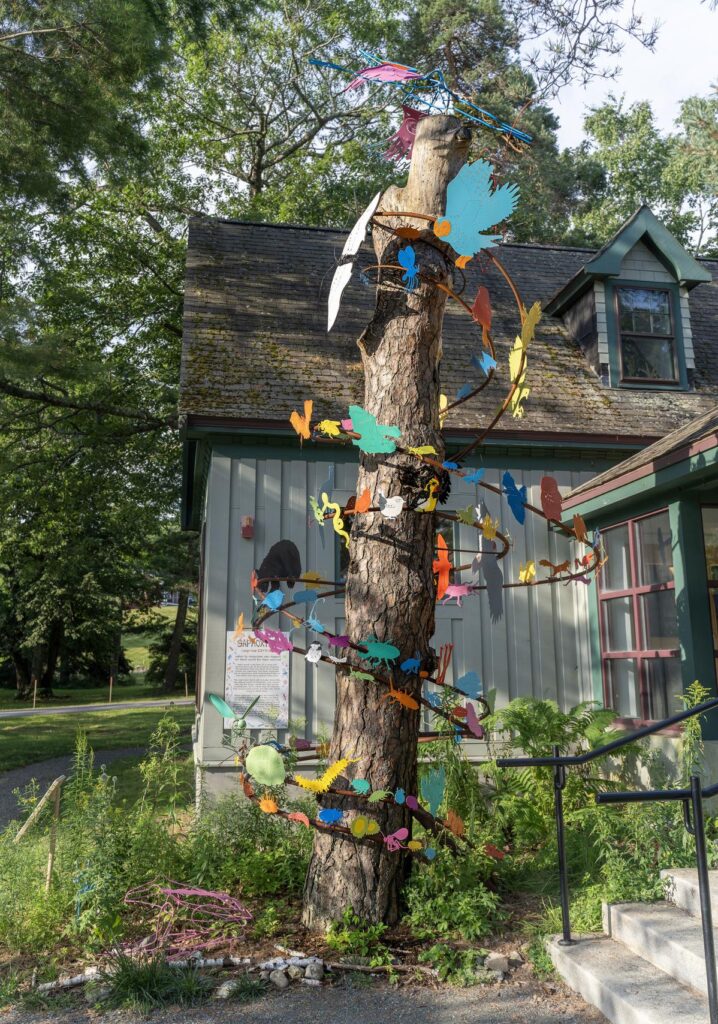
CL: That has me thinking about your piece “Dead Wood is Good,” located at the Dorr Museum of Natural History. What inspired the sculpture, and how does it interact with some of these ideas you’re talking about?
BH: The opportunity fell into my lap! I got my degree at College of the Atlantic. They were re-landscaping their natural history museum, and to make it ADA accessible, they had to kill a large old Scotch pine tree. It was the perfect opportunity: This is a natural history museum, teaching people about nature, but they were going to chop the tree into firewood, or put it in a wood chipper and destroy all evidence. I convinced them to keep the tree there, and my idea was to make a sculpture surrounding it that educates people about dead wood.
Safety concerns are a big reason people want to cut down dead trees, so the sculpture is a steel spiral embedded in a concrete footer at the bed of the tree. On the spiral are about 120 different creatures that live in dead wood in that particular part of Maine. You’ll see a sculpture of a creature, and it’s likely living inside the tree. You might even see it emerge, or land on the tree and hunt around. Some of the sculptures are of microbes, blown up a hundred times their size and brightly colored. It’s taking these invisible organisms we know are there through research, and enlarging them for everyone to learn about.
CL: College of the Atlantic is where you got your master’s of philosophy in human ecology. What is human ecology, and how does it influence your work?
BH: It’s a pretty wide-ranging field. Traditional ecology generally excludes human beings, as if humans don’t exist or have any impact. So a narrow definition of “human ecology” would be “including humans in the study of ecology”—how we’re impacting the environment, how we are ecological creatures as well. More broadly, it’s combining the sciences and humanities into one bucket and finding connections between them all. Society as an ecosystem. In my studies, I was focusing on the natural sciences I needed to make these sculptures work, and how they connect with the art.
CL: You and I met as artists-in-residence at WildAcres Retreat in North Carolina, where you were just beginning a new sculpture series. Do you want to tell me about that project?
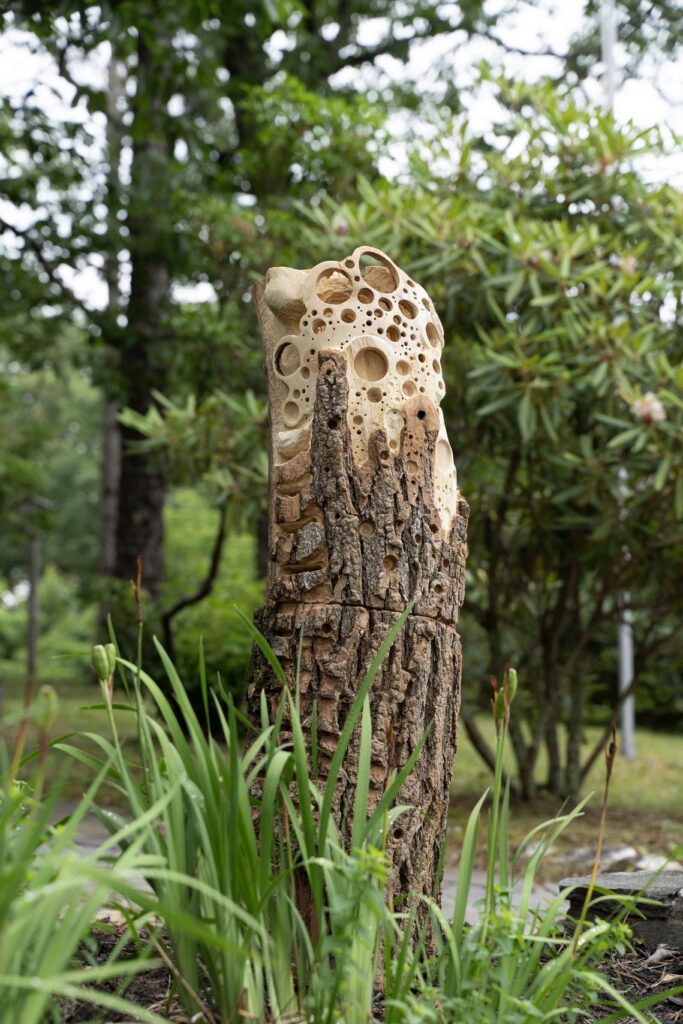
BH: Animals love cavities! I first realized this with my cat—you lift up a blanket and create a little cave, they’re immediately drawn to it. Animals have the instinct to use cavities as shelter from the elements, as a nest for reproduction. So it’s a form I’m trying to work with in my sculptures. But it’s a hard sculptural problem, because by definition, it’s something a human isn’t going to see. It could be beautiful and organic and geometric, but from the outside, it’s just going to look like a hole. I’m trying to think of how humans can still be an audience for these sculptures. I don’t know if they’re primary or secondary to the creatures, maybe secondary! But they still exist in a human environment.

The piece I created in North Carolina I made using these new tools I’m excited about, which can carve deep burrows into wood. People are using them in Australia for wildlife conservation—making holes in trees for sugar gliders, and all these adorable marsupials that are cavity-dwelling creatures.
It ended up being this pierced and punctured thing—probably over 100 holes, creating an almost lattice-type structure. Some holes are decorative, because they punch right through, but as you go further down the log, there starts to be more sizable cavities creatures could live in, surrounded by the decorative elements. There are really tiny tunnels, too, for cavity-nesting bees and wasps to lay their eggs. It’s a multi-species habitat sculpture—you’ve got the birds and mammals that can nest inside, you’ve got the native bees and wasps that can make their burrows. And the fact that it’s a piece of dead wood itself, it will decay and provide a home to all these dead wood organisms.
CL: Because your work is designed for critters, it invites a certain level of unpredictability. Has there ever been anything that shocked you in the way wildlife wanted to use it?
BH: Where I live in Maine, ocean breezes dump a lot of moisture, so lichens really flourish. There are these beautiful, under-appreciated creatures, which almost look like mushrooms with little red caps and fingers poking up out of the woods—I love lichens! So, I made a piece with two faces facing each other a couple of feet apart. Behind each of the faces, there’s a planter filled with dirt and wood and a bunch of lichens. Then there’s a glass tube going from one mouth to the other, and the idea was that insects would live in these little clumps of lichen and commute back and forth through this tube to hunt or breed, and you would see them walking back and forth.
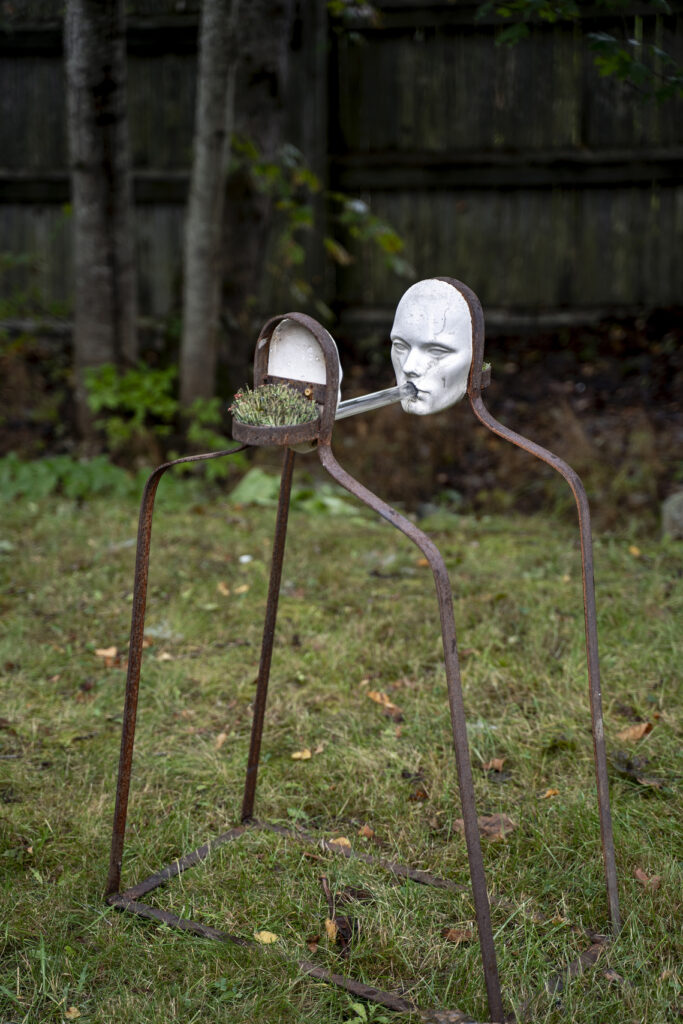
That was the concept. But maybe a week after I installed it, a spider had set up in the middle of the tube with funnel webs at both ends. The concept had worked so well—insects were coming in and out—that the spider set up and would eat whatever tried to come through! It’s kind of a perverse outcome, but still very, very cool. I never could have predicted something like that.
CL: I’ve often heard you talk about bioreceptive concrete—was this made from that material?
BH: This was before I started using bioreceptive concrete. But any cast sculpture or thing like that, I use it now.
CL: What exactly is bioreceptive concrete?
BH: Everyone’s seen moss growing on old concrete walls, or cracks where plants poke through—but most concrete doesn’t have anything living in it by design. People use plastic mixes in their concrete and try to make it smooth and shiny so nothing can latch onto it. Bioreceptive concrete, on the other hand, intentionally tries to make a hospitable surface for moss and plants to grow on and porous for creatures to live in.
You can hear a dry lecture on a subject and maybe that’ll move you to action, but art for me is all about the visceral emotional impact. If I can give someone a beautiful experience seeing a living creature in one of my installations, or send a message that sticks, I think that’s where my work as an ecological artist might be more beneficial than something academic.
A lot of research I use actually comes from concrete companies, explaining how to exclude life: “We did this experiment. If you mix this mineral in, there was 20% more moss, but if you use this other thing, there’s no moss at all.” I’ll do the opposite. I’ll add organic matter to make it absorb water and be full of holes that microorganisms can get into. I’ll mix in yogurt and rotting wood and dirt—it’ll still harden into a strong object, but there’ll be a matrix of organic matter throughout it. I also try to make sure the pH level is just right so organisms can grow on it, and that the concrete is full of different nutrients.
CL: That’s so cool. One last question for you: As an artist, how do you see your role when it comes to the environment?
BH: You can hear a dry lecture on a subject and maybe that’ll move you to action, but art for me is all about the visceral emotional impact. If I can give someone a beautiful experience seeing a living creature in one of my installations, or send a message that sticks, I think that’s where my work as an ecological artist might be more beneficial than something academic.
The other part is being able to explore more freely than scientists or conservation workers might be able to. I have the freedom to try really wild things, whereas a lab would have to apply for funding or write up progress reports on what they’re doing. They might raise eyebrows by trying something impractical or off the walls. Artists are able to do that. There doesn’t always have to be practical outcomes, but I think that taking a creative approach to things can yield some interesting outcomes.