

Note that if you purchase something via one of our links, including Amazon, we may earn a small commission.
Growing tomatoes and tradition on Martha’s Vineyard.
I’m Italian, so you could say tomato sauce runs in my blood. Ever since I was little, my Italian grandfather has had multiple gardens overflowing with tomatoes, grown from seed and pruned to perfection. Every summer, we picked ripe tomatoes, cucumbers, basil, figs, zucchini, beans; you name it, he planted it. You might even say I was a bit of a spoiled tomato myself, eating ripe vegetables straight from the garden.
Summer dinners were filled with just-picked veggies. We didn’t know any different, it was simply how we ate. Then, come fall, we’d jar all the tomatoes and savor those bright summer flavors all winter long. We poured them over pasta and meatballs, added them to soups, served them with chicken cutlets and spicy Italian sausage — however my grandmother felt like cooking that day.
(Funny fact: when we were little, we gave our grandmothers very accurate nicknames: My Italian grandmother was always cooking her amazing Italian food so naturally, we called her Grandma Meatball. My mom’s mother was a hairdresser who let us play in her salon chair, so she earned the nickname Grandma Haircut.)
Growing Roots
In 2009, I moved to Martha’s Vineyard to work in restaurants for the summer, my first time living away from home. That summer, I didn’t have the space or time to grow a garden of my own. I moved to the Island full-time in 2014 and the dream of gardening stayed with me. It wasn’t until 2020 that I finally had an apartment with some outdoor space. I started small, with basil, oregano, and rosemary. Nothing wildly successful, but I always managed to keep the basil hanging on.

While working for Bluedot Living, I got creative and sustainable by repurposing an old filing cabinet into a raised garden bed. I flipped it on its side, filled the bottom with leaves and wood for drainage, then topped it off with (a lot of) dirt. That’s where I planted my very first tomato plants!
Unfortunately, my rookie mistake was placing the planter in a sunny spot in early spring, but once the trees filled in, it didn’t get enough light. Not enough sun meant not enough tomatoes and the planter was far too heavy to move. Still, I wasn’t discouraged.
My 2025 Garden
This year, my garden lives in four galvanized metal buckets. (I passed my repurposed filing cabinet planter along to a friend whose home gets better sun.) I planted two tomato starts from a friend at Hamilton Homestead in West Tisbury, two cherry tomatoes from the Martha’s Vineyard High School plant sale, and one bright Sun Gold from the workshop. Nearby, a couple of pots are filled with a fragrant mix of basil, parsley, oregano, and rosemary — plus four pepper plants and some cheerful nasturtiums for a burst of color.
You might even say I was a bit of a spoiled tomato myself, eating ripe vegetables straight from the garden.
Since taking Lydia’s pruning workshop, I’ve been approaching my tomato plants with a new level of care and intention. Each morning, I head out to check on them, clipping a few leaves here, pinching off a sucker there. I’ve learned to look at each plant as a living structure, something to gently guide rather than just let grow wild. It’s not about cutting everything back, it’s about shaping the plant so it grows strong and healthy, with plenty of airflow and room for fruit to thrive.

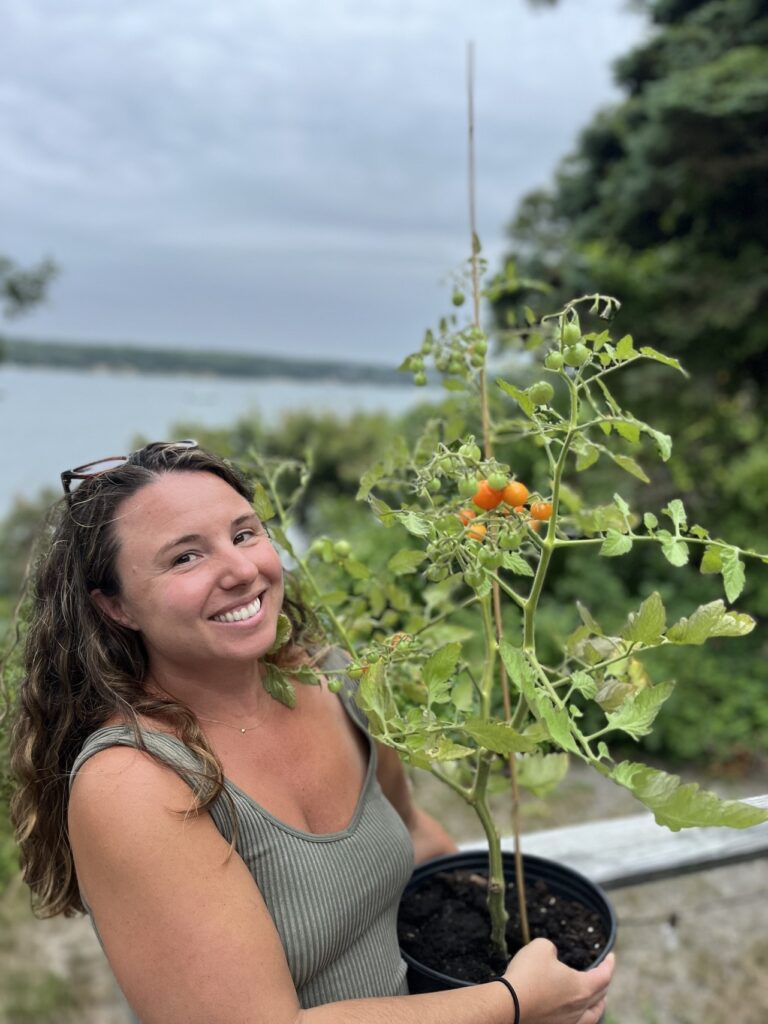
Instead of letting my tomatoes sprawl, I’ve been training them to grow upward using wooden stakes for support. I keep the base of each plant tidy, removing leaves that droop too low or look a little tired. It’s subtle work — sometimes just a small snip or shift — but it really makes a difference. The plants are thriving, full of life, and already showing off clusters of little green tomatoes. Some cherry tomatoes are even starting to turn red and ready for eating!
As an added bonus, after every pruning session, my hands smell like tomato plants, easily my favorite scent. It always brings me right back to childhood summers in my grandfather’s garden.
Honoring a Family Tradition
Someday, I hope to have a garden as big and bountiful as my grandfather’s. I may not be harvesting enough to jar my own tomatoes just yet, but I’ve still found ways to carry on the family tradition.
Growing a garden on the Vineyard feels like planting new roots while honoring the old ones, and there’s something really meaningful in that.
Over the past few Septembers, I’ve collected tomato “seconds” from farms across the Island: Ghost Island Farm, North Tabor Farm, and other local stands. These slightly bruised or overripe tomatoes are perfect for canning and usually sold by the pound. With around 10 pounds, I can fill about four jars, just enough to bring a little taste of summer into the colder months. I usually toss in some basil and spicy peppers to deepen the flavor.

It might only be a few jars, but to me, it means everything. It’s a way to carry on a family tradition and start something of my own. Growing a garden on the Vineyard feels like planting new roots while honoring the old ones, and there’s something really meaningful in that.
Tomato Pruning 101
This spring, I took the Tomato Pruning Workshop with Lydia Fischer of The Garden Farm, hosted by Lucy Grinnan at the Agricultural Hall. We each received a Sun Gold Cherry Tomato plant from The Garden Farm to work on during the class and take home afterward.
Lydia guided us through the anatomy of the tomato plant, using a helpful diagram to break it all down. They shared some really useful pruning tips.
Here are a few key takeaways:
- Keep the bottom third of the plant clear (except fruit clusters)
- Remove any leaves touching the ground to avoid disease
- Avoid pruning before heavy rain (plants are more vulnerable then)
- Don’t over-prune: leaves are important for absorbing sunlight
- Pruning helps redirect energy to make stronger fruit and a healthier plant
- Create airflow by removing dense foliage
- Use a trellis to keep plants upright and supported

How To Prune:
- Tame unruly growth so plants don’t take over the garden
- Pinch small suckers with your fingers
- Use clippers for larger suckers to avoid damage
- Train each plant to have two main stems, each with:
- Their own true leaves
- Their own suckers
- Their own fruit sets
- Avoid cutting the growth point: this is where new fruit comes from
- Think of it like “bonsai-ing” your tomato plant: focus its energy on growing intentionally
Tomato Varieties: What's the Difference?
Determinant Varieties
- Reach a set height
- Set all their fruit at once
- Require minimal pruning
- Great for sauce-making
Indeterminate Varieties
- Keep growing throughout the season
- Produce fruit continuously
- Better suited for cherry tomatoes like Sun Gold
Tomato Anatomy
Some plant anatomy we learned from class:
- Cotyledons: The first two baby leaves; they fall off naturally or can be plucked
- True Leaves: The plant’s mature leaves
- Growth Point: The top of the plant, don’t cut this! It’s where new fruit is produced
- Suckers: Little shoots that grow in the “V” between a leaf and the main stem; you can even propagate them
- White hairs on the stem: These are potential roots, plant your tomatoes deep so these root hairs can grow!
- Super Sucker: A sucker that grows from beneath the soil (great for propagation). These often appear when the plant is planted deeply.
Compost Tip
When pruning, avoid tossing tomato leaves into your regular compost pile. Discarded leaves can carry disease and compromise the health of your compost.
About Lydia Fischer and The Garden Farm: A Vegetable Farm Run by a 13th Generation Islander
Located in West Tisbury at Flat Point Farm. You can find Lydia and The Garden Farm produce this summer at:
- Edgartown Village Market – Tuesdays, 10 am – 2 pm (Last market is August 26th)
- West Tisbury Farmers Market – Saturdays, 9 am – 12 pm, (Last Saturday Market is October 25th)
Check for updates from The Garden Farm on instagram @thegardenfarmmv, or on the website.

Learn and Grow with the Martha’s Vineyard Agricultural Society
Click here to find upcoming classes and workshops hosted by the Martha’s Vineyard Agricultural Society, from gardening and composting to beekeeping and cooking.
For more information about classes and programs at the Ag Hall on follow them instagram @mvagriculturalsociety.
Read more about how to protect your tomatoes.
Recipes to try: Daddy Soup and Canned Tomatoes.


Made it and felt like I was wasting so much good tomato juice.