Note that if you purchase something via one of our links, including Amazon, we may earn a small commission.
University of San Diego architecture professor Daniel Lopez-Perez wants to ease the housing crisis by building greener, faster, and cheaper.
Since the recent catastrophic Los Angeles fires, Californians are dreaming more than ever of affordable, fire-resistant housing that can be constructed quickly with sustainable materials. La Jolla-based architecture professor Daniel Lopez-Perez may have the solution.
Daniel came to San Diego in 2009 to start an architecture program at University of San Diego. In addition to teaching, he’s an avid researcher in how technology used to design tall buildings can be scaled down to residential units. Daniel’s enthusiasm and positive outlook are striking as he talks about his design and building technology company, Polyhaus. He’s currently making prototypes of 10 different units he thinks could help solve the housing crisis in California and beyond.
Applying High Tech to Housing
According to the Brookings Institute, estimates of the national housing shortage vary wildly, from 1.5 to 5.5 million units. Regardless, there’s a lot of need.
Right now builders design each house individually and construct them one two-by-four at a time, Daniel says. “There is a huge technology gap between the scale of these projects and projects slightly larger,” he says. “By the time you get to apartment buildings of about 25, 30 units, these are highly efficient, highly industrialized buildings.” Daniel is focusing on using mass timber for infill residential construction below 20 units.
“Mass timber” refers to engineered wood components that can be used in place of steel or concrete to create a structure that provides durable, cost-effective performance with less embodied carbon. Mass timber was invented in Austria and Germany in the 1990s. Cross-laminated timber, a type of mass timber, is an engineered wood product that compresses thick planks of wood into layers. These robotically made panels come in 4- or 5-foot widths and can be 40- to 60-feet long, and up to a foot thick. With fewer pieces, building goes much more quickly. Polyhaus’ partner Vaagen Timbers can manufacture the 60 panels necessary for a 540-foot structure in less than 24 hours. Once the panels are trucked to the construction site, building takes 8 to 12 weeks. A vapor barrier and insulated metal panels are added to the exterior.
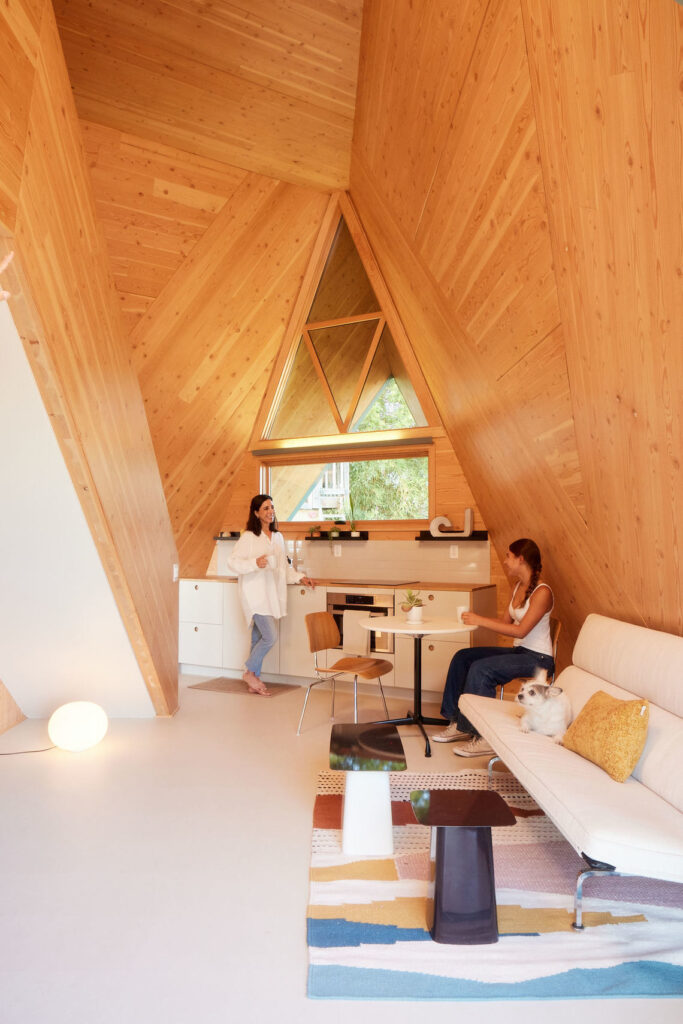

In addition to the largely metal exterior, the lack of air gaps in mass timber makes it more fire-resistant. “The problem with open older structures, these ember rain showers come in,” says Daniel. “So they start to burn from inside, from within the wall cavities. Mass timber gives you this sealed layer that is really rigid and inevitably has more resilience.”
Mass Timber and Sustainability
According to the World Economic Forum, global cement manufacturing is responsible for about 8% of the world’s total CO2 emissions. Many — though not all — experts say that building with mass timber can significantly reduce this.
Vaagen Timbers, based in Colville, Washington, sources its Douglas fir from a nearby forest. Daniel emphasizes that without proper forest management — i.e., cutting down some trees — wildfires are more catastrophic. “So the federal government works with local forest rangers and then local mills to go into forests and in a very careful and meticulous way re-harvest one acre at a time,” he explains. “There is suddenly a direct connection between housing production and the health of our forests.”
Tetra-One and Beyond
So far, Daniel has completed a prototype of the 540-square-foot Tetra-One in his backyard. It includes a kitchen, bathroom, living room, small “bonus area,” and a sleeping loft. Because the Tetra-One was permitted on Daniel’s property, it is pre-permitted for San Diego County, and Polyhaus is ready to take orders for both the Tetra-One and larger Tetra-Two. The two-story Tetra-Two is twice the size, with two bedrooms, two bathrooms, and a carport. It’s still in the permitting process and Polyhaus has submitted Tetra-One for statewide approval. The 10 models that Polyhaus hopes to have permitted by this summer range up to 2,500 square feet. They can be combined to form a Poly-Village, Daniel’s modern take on the SoCal bungalow court.
None of this makes sense unless we match conventional price-per-square-foot. Right now, we’re matching that in San Diego.
– Daniel Lopez-Perez, founder of Polyhaus
Polyhaus commits to matching conventional construction prices, and has achieved this in San Diego, Daniel said. This places the Tetra-One in the mid-$200K range. He hopes to capitalize on economies of scale, where prices drop significantly when the mass timber plant fabricates multiple units. Daniel emphasizes that Polyhaus does not manufacture tiny houses, which fall into a different zoning designation since they lack conventional foundations and must be able to be moved at any time. Nor does he make prefab units in another country with questionable materials or labor practices. Polyhaus prides itself on crafting real houses, sustainably.
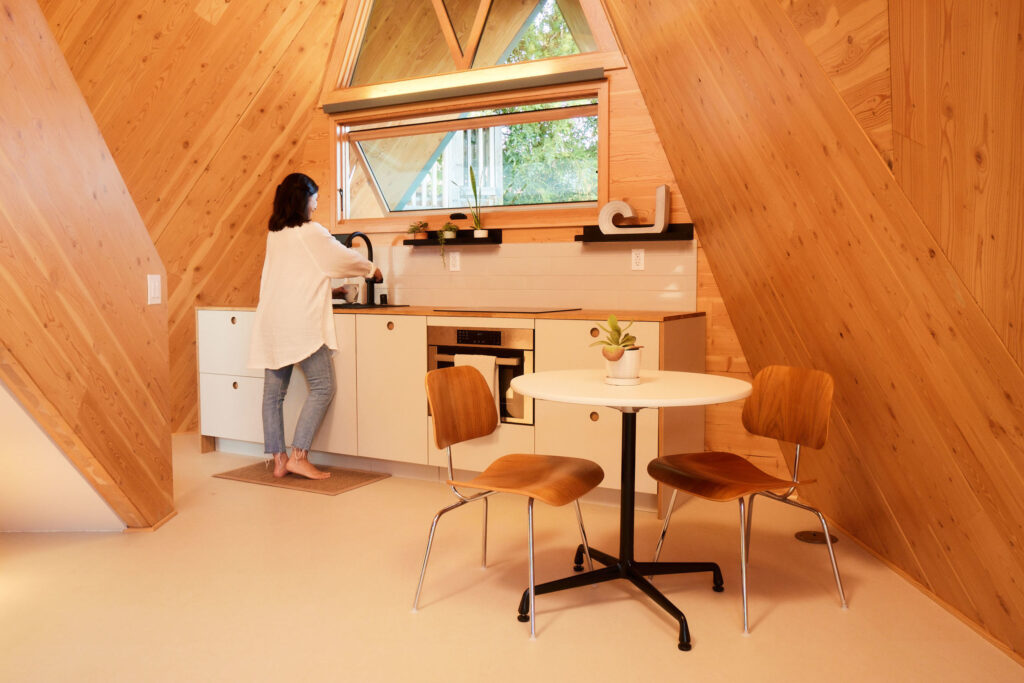
Daniel approaches Polyhaus as a scalable system that will improve over iterations. “We believe that as you make unit number two and unit number three and unit number four, the units themselves get smarter, just like our cars and our phones do. So the virtue of the system is not just the efficiency of repetition, but it’s also learning from one unit to the next and making them smarter.”
For more information, check out the Polyhaus website.