Note that if you purchase something via one of our links, including Amazon, we may earn a small commission.
The Chief Counsel of the Environmental Defense Center has been battling Big Oil, and winning, for decades.
In the story of David and Goliath, a young shepherd defeats the giant warrior, reminding us that seemingly defenseless people, by dint of courage and determination, can triumph over fierce adversaries.
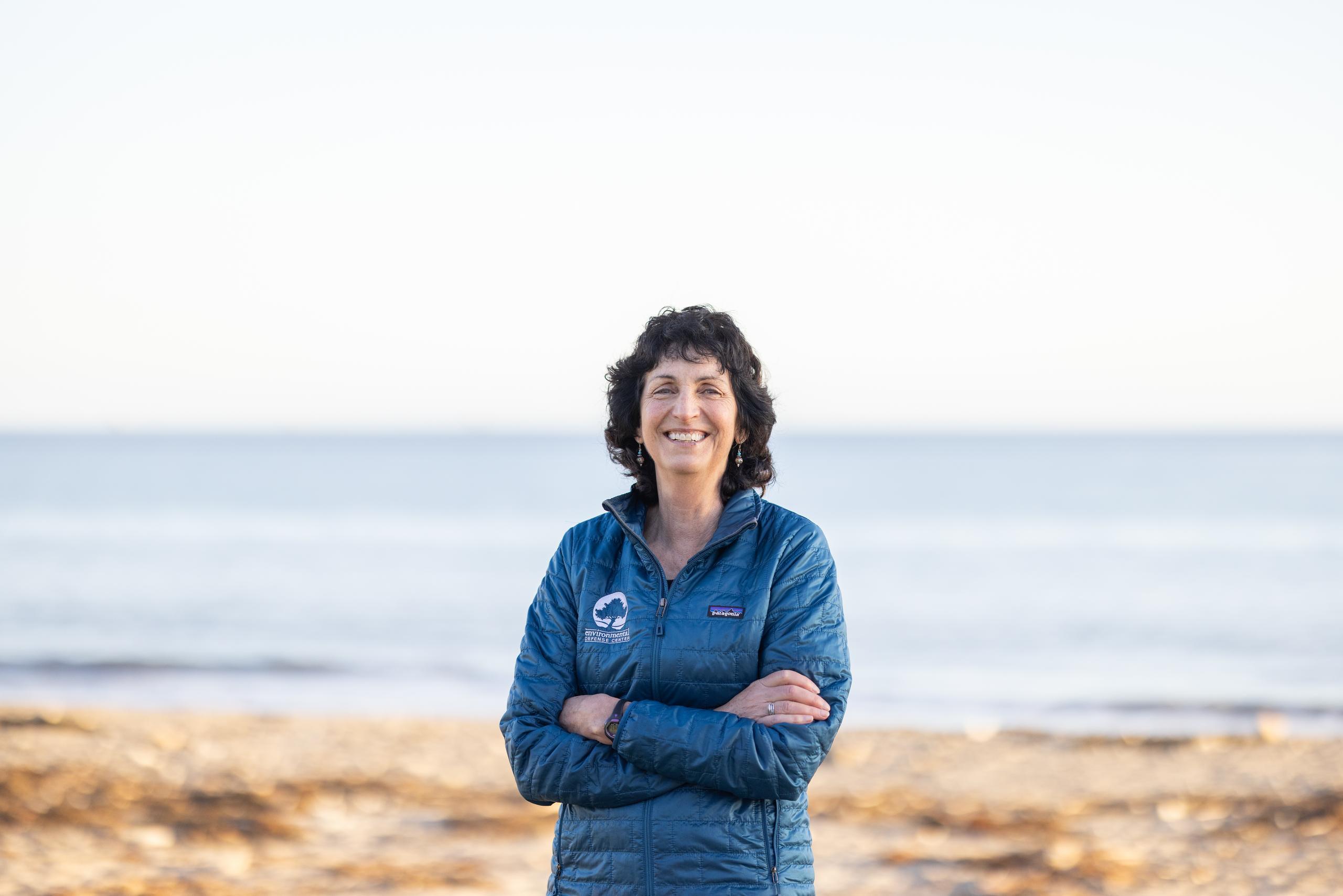
In Santa Barbara, there’s Linda Krop — the chief counsel of the Environmental Defense Center (EDC) who has taken on big oil many times, including the ExxonMobil behemoth, and won.
Santa Barbara environmentalist John Steed, who for years was a top corporate attorney, said of Linda: “I’ve managed dozens of attorneys over the years and Linda Krop is maybe the best I’ve ever seen.” And now she’s taking on the giants again.
Many Santa Barbarans might assume oil drilling in the Santa Barbara Channel is a thing of the past, that the platforms will be decommissioned as we move toward a cleaner energy future. That’s not true. Yet.
Companies have drilled for oil off Santa Barbara’s coast for over a century. But on January 28,1969, a blow out on Union Oil Platform A caused a massive oil spill in the Channel. When it was finally plugged, 4.2 million gallons had polluted the ocean and the beach. It was, then, the largest oil spill in U.S. history.
The sight of the Pacific Ocean, with its blackened waves silently hitting the shore too ladened with oil to make a sound as thousands of sea birds and animals lay dying along its beaches, shocked the world.
Here in Santa Barbara groups formed to prevent such a disaster from ever happening again. The Environmental Defense Center was born from this movement. Eventually it became the leading legal group fighting to protect the region’s land, air, and the people who live here from ecological destruction.
In 2015, another oil spill occurred at Refugio State Beach. Thick,crude oil from an ExxonMobil platform was moving through a badly corroded pipeline, then belonging to the company, Plains All American. It ruptured undetected, without a shut off valve, and spilled around 140,000 gallons of oil, polluting the ocean and the land.
Linda Krop and the EDC team were part of the legal battles that forced the companies responsible to pay over $700 million in liability and criminal negligence damages. The platforms were shuttered and oil drilling ceased along the Santa Barbara Gaviota coast.
ExxonMobil didn’t give up. In 2020 it took another stab at extracting offshore oil from Santa Barbara, planning to circumvent the corroded pipeline by trucking the oil to processing facilities in Kern County. The company proposed that a fleet of trucks would transport 70,000 barrels a day 150 miles up the 101 and 166 highways.
Krop and her team again rallied, arguing before the Santa Barbara County Board of Supervisors showing that trucking accidents on these routes made such a plan extremely dangerous both to people and the vulnerable ecosystems bordering the route. The board voted 3 to 2 to deny Exxon a needed permit.
Now off-shore oil production is again being proposed. ExxonMobil has entered into an agreement to transfer the leases for its local operations to Sable Offshore Oil, offloading their assets to a new company that claims it can repair the “anomalies” on the rusty pipeline. To restart, Sable requires permits or permissions from various state and local agencies including the Santa Barbara Planning Commission and Board of Supervisors. So far, Sable and Exxon are winning the permissions at the state and local level.
I sat down with Linda at the Handlebar Cafe (and again on Zoom) to understand what’s going on. Could it be possible that the County of Santa Barbara would allow a company with no track record to restart oil production and transport it through a pipeline with a well documented history of corrosion?
“It could be,” she said, speaking with crisp clarity, though occasionally adding an ironic laugh at the incredulity of it all. She walked me through the history and the labyrinth of local and state agencies involved. Alex Katz, the Environmental Defense Center CEO, joined us and filled in details.
Vicki Riskin: It strikes me that taking on Exxon and the other oil companies is a big task and you seem to have done it over and over again.
Linda Krop: Well, that’s why the Environmental Defense Council was formed after the 1969 oil spill. It was really to be the voice of the community and to empower the community to stand up to the giants like the oil industry that caused the ’69 spill. We have lots of great tools at our disposal.
One of the silver linings of the ’69 oil spill though was the environmental protection laws that we use today that were passed at the state and federal level. Those are the laws we use to defeat oil projects, gas power plants, and other LNG [Liquified Natural Gas] projects. And I’m just really proud of EDC for standing up.
VR: And then there was the 2015 oil spill, that many people remember.
LK: The oil spill occurred in the morning. I got a call in the afternoon from a retired firefighter for the county who used to work in the county’s Oil Spill Response Program, and he had been surfing that morning at Refugio State Beach Park. He was there when the oil spill was first discovered and was horrified because a response was not immediately deployed.
We could see the ocean was full of this thick, foamy, black oil … and then every little wave brought it up onto the beach. So the beach was coated, you know, really stank. And we saw the ship that helps with offshore oil spills sitting way offshore not doing anything, because the oil spill was from onshore.
– Linda Krop, Chief Counsel of the Environmental Defense Center, on the 2015 Refugio Oil Spill
You had this oil spilling out of this culvert onto the beach, into the ocean, and nothing was happening. Everyone was standing around waiting for the Coast Guard to show up, and he knew because of his previous work that they [the “Unified Command,” meaning the U.S. Coast Guard, CA Department of Fish and Wildlife, County of Santa Barbara, and Plains All American Pipeline Company] were supposed to be there containing the oil, make sure it’s not entering the ocean and getting on the beaches, and yet nothing was happening. So he called me and said, “You gotta get over here.”
We were able to get access and it was traumatizing, because we could see the ocean was full of this thick, foamy, black oil … and then every little wave brought it up onto the beach. So the beach was coated, you know, it really stank. And we saw the ship that helps with offshore oil spills sitting way offshore not doing anything, because the oil spill was from onshore.
I remember, there was one guy in a hazmat suit walking on the beach, and everyone else was waiting for their orders, for equipment to show up, vessels to show up. When the Coast Guard captain showed up, it was early evening. The agency folks met around nine o’clock and held a press conference. A lot of national media showed up, asking, “What’s the plan? How are you going to deal with this?” And the Coast Guard captain who was head of the Unified Command overseeing the oil spill response said, “Now it’s dark, it’s night, and we’ll wait for the morning, and we’ll come up with a plan.”
VR: How could there not have been a plan?
LK: I knew, having worked in this field for decades, that they had a plan! Every oil and gas facility, whether it’s a platform or a refinery or a pipeline, has to have an oil spill contingency plan so you know what’s going to happen if there’s an accident. They just didn’t use it. The media was taking notes and nodding — oh, okay, they’re going to come up with a plan in the morning. I’m trying to raise my hand at this press conference saying, “There is a plan! Why wasn’t it followed? The main response didn’t start until almost 24 hours after the spill and, and that’s why a bunch of oil spilled into the ocean.”
The other thing that caused so much oil to spill unnecessarily is that the owner of the pipeline, Plains All American Pipeline Company, did not shut off the pipeline right away. It should have been shut down immediately and oil may never have reached the ocean. It was flowing for a couple hours. Some oil traveled 150 miles down the California coast.
VR: I’m curious about when you decided to make environmentalism your career.
LK: I definitely grew up loving nature. And my parents also exposed us to Native American culture. I was really inspired by how Native Americans view our relationship with nature. And then I grew up with a mom who was very, very politically and socially active, and so she had me going to rallies and working on campaigns since I was probably 5 years old. When I got to UCSB, the two merged, because UCSB was where one of the first environmental studies programs in the country was formed. I combined my love of nature with my activism background. It was effortless and just really stoked my passion.
VR: What made you think the law was a good avenue for your passion?
I teach environmental law at UCSB and tell students that I’m an accidental lawyer. Unlike some people who know they want to be a lawyer, I wanted to be an environmental advocate and I didn’t know how to approach that. So friends of mine suggested I talk to Marc McGinnes, who taught environmental law at UCSB and founded the Environmental Defense Center. He said, “You should be an environmental lawyer, and maybe you can come work at EDC.” And my first reaction was, “Oh, my God, I won’t like law school!”
I had seen Marc at hearings in front of the decision makers. They listen to lawyers more than to the general public. He offered me an internship. I went to the Santa Barbara College of Law while I interned at the EDC and just loved it. That’s when I got into the oil issues, because one of the first cases I worked on as a law clerk was trying to stop Chevron from installing its platforms off the Gaviota Coast and building that big processing plant at Gaviota.
VR: How did that case turn out?
LK: The platforms did get installed. The plant got built. But because of the pressure from the environmental community, the county adopted some stronger policies. One was the requirement that the county would no longer allow barging or tankering, so that stopped. And the other one was that they had to comply with the county’s air quality rules, so they had to result in a reduction of their air emissions in the county.
VR: You’ve been involved in lots of different cases over the years. Is there a standout?
LK: Probably the most impactful case was one where we came up with an idea for the state to be able to challenge 40 federal oil leases. Out of the 83 leases that had been granted by the federal government, about 40 were not developed yet, and so we initiated a legal theory that the state coastal commission and governor joined to terminate those 40 leases, so they could never be developed. Basically, we got rid of half of the potential oil and gas development off the coast of California. That’s pretty good. That case went up to the Ninth Circuit Court of Appeals, and we won. It’s a great example of the fact that so many of our victories are things people don’t see and don’t know about. We could have had twice as many platforms off of our coast.
VR: How many platforms are there?
LK: There are over 20 platforms, and most in our area, a few down south. Eight of them are no longer producing. So when that happens, they have to enter into what’s called the decommissioning phase. When these platforms were installed, the oil companies agreed that when they finished extracting the oil and gas, they would then remove everything and restore the ocean to its natural condition. That’s the basis on which “the people,” who own the ocean, lease the drilling rights.
Now they want to save money by leaving them or leaving them partly there. Under current law, they can apply to do that and show that it would be better for the marine environment than removing them completely. The federal government just completed an environmental evaluation looking at different decommissioning options, from fully removing the platforms to partially removing them, and determined that the best for the marine environment was full removal.
So eight are permanently shut down, and six of those are entering the decommissioning phase to start early this year.
VR: Who owns those eight?
LK: [Platform] Holly was owned most recently by Veneco, who declared bankruptcy in 2017 so now the State of California is responsible. Fortunately the prior owner, ExxonMobil, still has obligations for decommissioning, is working with the state, and paying for most of the cost of decommissioning the platform. This will be the first test of decommissioning off California in probably 30 years.
It’s really important people follow what’s going to happen, because it could set a precedent.
The other platforms off the Gaviota coast up north at Point Conception are the ones that Chevron installed, and they are completely shut down. They will start going through the decommissioning process, probably later this year.
With some assets where they can’t make enough money, big companies like ExxonMobil sell their lease rights to smaller companies like Sable Offshore Oil.
VR: Let’s talk about Sable Offshore Oil.
LK: Sable wants to take the fast track to restart, and doesn’t want to wait to get approvals and construct a whole new pipeline. They are just going to restart the existing pipeline — it’s such a dangerous proposition — because we know it’s corroded. Even if they put in new valves to detect leaks, as required by state law, that doesn’t prevent a leak.
The county’s own environmental experts determined that, with this pipeline, there is a risk of a spill every year, a rupture like 2015 every four years, and a spill that could be almost twice the size of what happened in 2015. We know what the consequences are so we’re fighting this aggressively.
If the pipeline and platforms restart, it would increase oil production in California by 20% and interfere with our ability to meet our county climate or air quality goals or climate action plan, because the greenhouse gas emissions will be huge from this project. It could possibly double all of the county’s greenhouse gas emissions. So it’s really a step backwards.
Sable wants to take the fast track to restart, and doesn’t want to wait to get approvals and construct a whole new pipeline. They are just going to restart the existing pipeline — it’s such a dangerous proposition — because we know it’s corroded.
– Linda Krop
And one thing I like to point out to people is, we’re all very, very worried about the Trump administration coming in, and what that could mean for offshore oil development in California. I think the biggest risk to California is the Sable project.
VR: Really? Why not the whole coast?
LK: The Trump administration is limited in what they can do off of California.
One of the areas that has the most remaining oil and gas reserves is called the Santa Maria basin, which is between Point Conception and the San Luis Obispo County border. We have a new National Marine Sanctuary there now so they can’t drill there anymore.
Perhaps more importantly, President Biden just withdrew all remaining areas offshore of California from federal oil leasing. Combined with California’s ban, this means that no new areas can be leased for oil and gas development off California. So to me, the biggest threat of offshore oil and gas off California is the Sable project.
VR: I was surprised the Santa Barbara County Planning Commission apparently gave ExxonMobil permission to transfer their lease to Sable so easily.
LK: We were shocked at the lack of in-depth review. The county has an ordinance that requires its approval to transfer a lease. We argued the county should not transfer the permits, because Sable hasn’t shown it has the financial resources to safely operate these facilities or respond to an oil spill. It doesn’t even have approved oil spill contingency plans. It keeps submitting deficient ones. It hasn’t shown that it can safely operate. It has notices of violations from not just the California Coastal Commission, but now also the Regional Water Quality Control Board. They violated the Clean Water Act as well.
Sable hasn’t shown that they have adequate insurance or bonds, but the county staff didn’t require them to show these things with any detail. They said it’s kind of a paper transfer. But Sable is in debt. They borrowed almost $800 million from Exxon to buy this project. They have no other assets. They have no other revenue if they don’t start operating. We don’t know if they have enough money to operate safely when things go right, but if there’s an oil spill, they don’t have the money to deal with that.
And unlike the decommissioning responsibility that stays with the seller, ExxonMobil will have no responsibility because they didn’t install these assets. If there’s an oil spill on Sable’s watch due to their negligence, they’re not going to have the money to clean it up.
VR: I know you have a strong coalition of environmental groups working on this with you.
LK: We have a great group. As a law firm, our clients include Get Oil Out, the Santa Barbara County Action Network, the Sierra Club, Santa Barbara Channelkeeper, Center for Biological Diversity, Surfrider Foundation, and others. We’re a very close-knit coalition and have already been successful to some extent because Sable, in trying to attract investors, said that it was going to restart all of these facilities in September 2024, and then October 2024, and then December. Now they’re saying early 2025, but they still are shut down because of the coastal commission, and still don’t have approvals from many other agencies.
VR: Thank you Linda, for what you and EDC are doing.