

Note that if you purchase something via one of our links, including Amazon, we may earn a small commission.
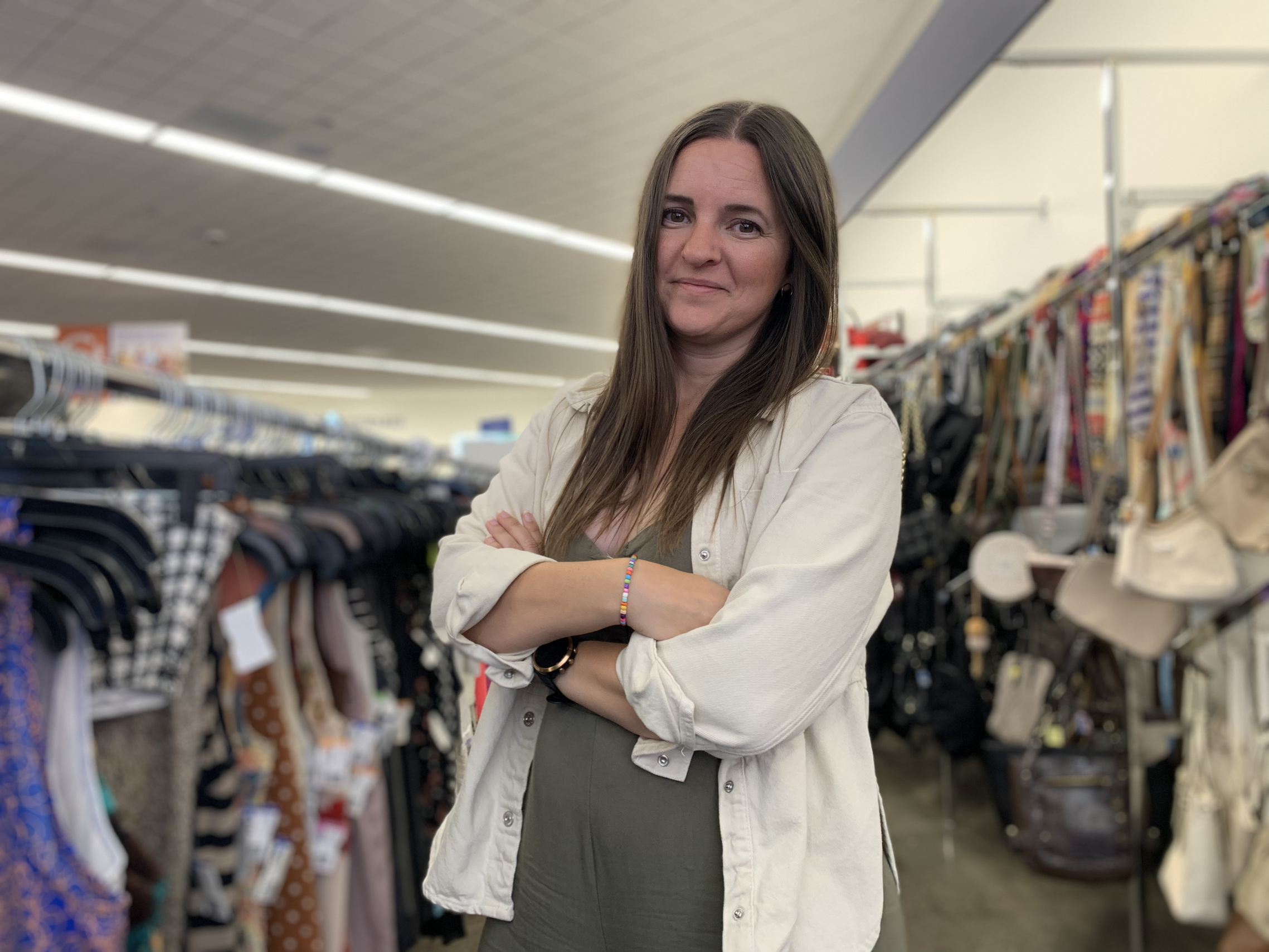
Shopping in thrift stores set me on a journey to more sustainable living.
It’s been two years since I’ve supported a fast-fashion company — two years since I dropped $80 on Old Navy outfits for my three daughters so our Christmas card photos could look shopping catalog–level coordinated, two years since I bought myself a brand-new dress for a wedding, and two years since I bought an H&M sweater to follow a trend only to realize that trend does not work for my body, so there it hangs in my closet, shaming me.
And it feels so good.
Sustainable shopping was not on my radar until a few years ago. With three young kids and full-time, in-office work, I did what everyone in my season of life did: I took the convenient route. When I was at Target to buy more baby wipes, I’d swing by the kids’ section to buy my girls seasonal St. Patrick’s Day outfits or matching Christmas jammies. When picking up more paper towels from Costco, I’d browse the center section for a new jacket. Or when I ordered more pacifiers on Amazon, I’d throw in some cute headbands for my kids’ Easter baskets — they were so cheap! It was innocent enough. I was being budget-conscious, I was never extravagant, and I was never above using hand-me-downs. But I never stopped to think where these things came from, or about who or what was being hurt by my decision.
My Journey to Sustainable Shopping
In August 2021, I went on an eight-day backpacking trip on the John Muir Trail in the Sierra Nevada Mountains. The trip was led by an organization called The Freedom Challenge, which uses physical challenges to raise funds and awareness to free enslaved women and children around the world. Through that organization, I learned about how much labor trafficking the fashion industry is responsible for — there are an estimated 60 million factory workers working in the industry, and it’s estimated that less than 2% of them make a living wage.
Around the same time, two friends from high school started a company called Hand Me Up Shop, which is on a mission to save the planet by reducing textile waste, starting with kids’ clothing. Did you know more than 80% of donated clothes end up incinerated or in landfills? That means dropping off my unwanted clothes at Goodwill doesn’t leave me with a lighter, clearer conscience — I’m contributing to the problem!

My clothes shopping was put in a new light. It gave me pause when another holiday or birthday or Instagram-worthy special occasion was coming — maybe we didn’t have to buy new outfits. Could we use what we already had? And I didn’t realize how addicted I was to the convenience of walking into a single store and walking out with exactly what I wanted on the same day (thanks, American consumerism). To change my shopping habits, I had to go cold turkey on shopping for a bit. I’d order online instead of going on a Target run. I’d steer clear of malls and Costco center aisles. Then I started thrifting.
Starting a (Thrifting) Fashion Trend
The thrift store solved multiple problems for me: First, it gave me a way to buy new(ish) outfits when I needed them without supporting the fast-fashion industry and without spending a lot of money. It also didn’t tempt me with a giant display of the latest microtrend — I picked what I liked, regardless of the trends, and I exercised more creativity in my outfits. And finally, it helped me feel like I was being more intentional with my shopping: I was helping the planet (keeping clothing out of landfills!) and people (funding charitable organizations) along the way.
Shopping sustainably led to seeking out more ways we could live sustainably as a family. We started growing our own food, raising chickens, composting more, and reducing our yard waste. We started buying practical home items, like baking sheets and mixing bowls, secondhand too.
Lessons Learned from my Secondhand Journey
While I’m still relatively early in my sustainable shopping journey, I’ve learned a few lessons that I hope will help others just starting out.
Be patient, and keep an open mind

Secondhand shopping, whether for home decor or clothing, is much slower than using an Amazon app. It might take multiple trips to multiple stores, and you might not always find exactly what you envisioned. (This is also why I start hunting for Halloween costumes in July.) I’ve learned that keeping an open mind has helped me find some items that I wouldn’t have normally considered — I look for a skirt, not a specific color or length, or I look for birthday gifts for my kids without having any specific idea in mind. But I will say that while it requires more patience, planning, and creativity, finding thrifted treasures is so much more satisfying than browsing the Target aisles.
Find ways to avoid buying things
Have you heard of the Buy Nothing Project? It creates communities, usually through Facebook groups in neighborhoods, as part of a global reuse economy. Through these geographically restricted groups, participants can swap items in an attempt to keep items out of landfills and give them new homes. From half a box of unused diapers to birthday party decorations to CSA box leftovers and appliances (that’s how we got our garage fridge!), neighbors trade items. If you’re considering buying something new, say a new tool, you can also put a request into your Buy Nothing community to see if anyone has that tool for you to have or borrow for your project before you go buy it. These powerful groups build community while helping the environment.
Don’t give up if you can’t find what you’re looking for
Sustainable shopping can feel like playing the long game, but thrift stores aren’t your only option. If I’m looking for something specific, I start with thrift stores, then move on to my local Buy Nothing group, then search on Facebook Marketplace. If I still can’t find what I need and it’s urgent, I shop at small businesses, because if I’m going to buy new, I want my money to go to supporting a local small business.
Borrow from neighbors and friends
We took our daughter to Disneyland recently for her fifth birthday, and I owned no Disney clothes. The old me would have searched online for a few minutes for a cute Minnie Mouse shirt and purchased it immediately. The new me texted a friend, a former Disneyland annual pass holder, to ask to borrow a shirt for our Disney day. Are there things you’re thinking of buying that you would only use once or twice and could borrow instead, like an extension ladder to trim some trees or a fold-up table for hosting a party? Lean on those around you instead of buying new as your default.
Shopping sustainably led to seeking out more ways we could live sustainably as a family. We started growing our own food, raising chickens, composting more, and reducing our yard waste. We started buying practical home items, like baking sheets and mixing bowls, secondhand too.
Extend the life of the clothing you have
This might take some creativity — find new combos of outfits so they feel new. And you might need to gain skills at cleaning and repairing. Pinterest is a valuable search engine for tips on removing specific stains, and there are online tutorials all over social media for what’s called visible mending, an ornamental approach to repairing an item.
Don’t follow the trends
The average article of clothing is only worn seven times before it’s discarded. Never before has clothing felt so “disposable.” Social media has fueled trends and even microtrends (lasting a month or shorter instead of a season). Following the trends costs money, hurts the environment, and fuels the fast-fashion industry. On top of that, I’ve found that I’ve lost my sense of style when I watch what others wear and try to match it. It’s best to find what you like, what fits your body, then wear it confidently — and make sure you’ll wear it more than seven times before moving on from it.

Purge responsibly
According to the Council for Textile Recycling, the average American creates 70 pounds of clothing and textile waste every year. Be more intentional with where your textile waste goes. Repurpose old baby bibs and T-shirts as rags, and gift your still wearable clothes to your Buy Nothing community. But for the clothes that can’t be cleaned or mended (i.e., most of my kids’ clothes), do your research to find a way to recycle the textiles. I’ve been using the Trashie Take Back Bags for a year now, and they make me feel so good about recycling my textiles — Trashie sorts the textiles into 253 grades to improve their reuse and recycling efficiency, and 90% of what they receive is kept out of landfills.
Start small
If you’re new to shopping sustainably, buy one thing secondhand that you would normally buy new, or make one article of clothing last longer than you would have normally by repairing or cleaning it. Sustainable shopping might seem like a small action to take, but these actions add up.
Margaret Mead, an American cultural anthropologist popular in the 1960s and 1970s, once said, “Never doubt that a small group of thoughtful committed individuals can change the world. In fact, it’s the only thing that ever has.” And I’m hopeful that my individual commitment to sustainable shopping can contribute to something much bigger.

I am a thrifty shopper as I most of the time buy my clothing at thrift stores, which is my fav, or GW, or some on-line at SHEIN but I’ve read bad things on that co so I’m staying clear of it now. When my closet gets too busy I sell to thrift stores to make a few bucks or give it to the needy whom I know. Happy shopping and thrifting as I enjoyed your article!
All people in industrialized countries need to look closely at their habits to reduce or remove habits that contribute to the ruination of the planet. We needed to start ten years ago, at least. So everyone needs to do their part, if we have any chance of saving our planet and ourselves. Don’t believe me? Keep the same habits, if you dare, and see where we end up in 5 years.