

Note that if you purchase something via one of our links, including Amazon, we may earn a small commission.
Here’s how and why you should eat more anchovies and sardines.
Available on Apple and Spotify.
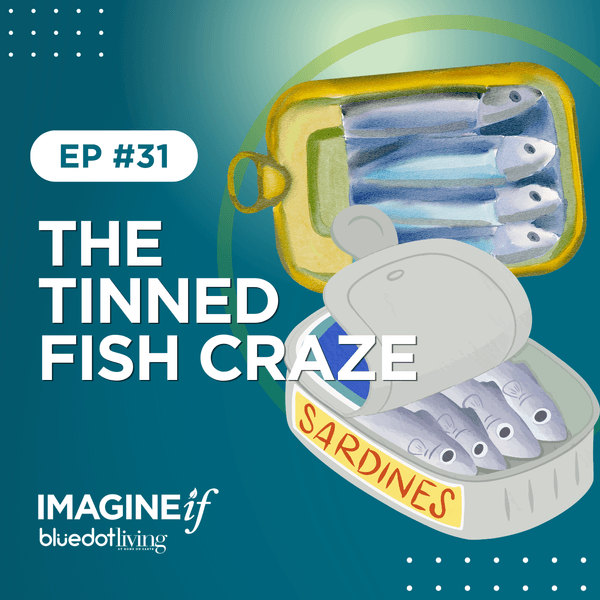
In this episode of the Pantry to Dinner series, Victoria Riskin and Caroline Saunders make the case for two of the most overlooked ingredients in the pantry: anchovies and sardines. Because it turns out, these tiny fish might be some of the most climate-friendly things in your kitchen — right up there with tofu.
From a simple yet elegant Caesar dressing to an addictive caper-studded chicken dish, this conversation is a tour of everything a can of anchovies or sardines can become, and just how far a single tin can stretch.
In this episode, you’ll hear:
- The difference between brown and silver anchovies, and when to use each.
- Easy tinned fish recipes.
- Why anchovies and sardines are an unusually climate-friendly protein.
About Caroline Saunders:
Caroline Saunders is a strategy and operations leader working at the intersection of media, climate, and sustainable food systems. She is the managing director and editor-in-chief of The SUNN Post, a national nonprofit student newspaper amplifying young voices. Previously, she served as chief of staff at Grist, and she has written about sustainable food for outlets like The Guardian, Bluedot Living Kitchen, and SAVEUR. She also holds a pastry diploma from Le Cordon Bleu Paris, bringing a unique perspective to food and sustainability.
Meet the Host:
Victoria Riskin: I am Victoria. I’m always looking for the best life has to offer despite a turbulent world. I find comfort in the environment and joy in friendships. We have a great team of all ages at Bluedot who inspire me every day as we work together to build community.
Transcript
Victoria Riskin: Sardines and anchovies have a lot to offer, and they get short shrift. They're not only short in size, but they get a short shrift. But I think they're having a renaissance.
Welcome to the Bluedot Imagine If podcast. I'm Victoria Riskin, founder of Bluedot Living, and I'm here to offer you some ideas for your pantry and some easy ways of cooking, and to save you some money at the same time, we hope, and care for the planet. The kitchen is the entryway to some important planet-friendly solutions. So I created this Imagine If mini podcast called Pantry to Dinner.
Caroline Saunders, it is so good to see you again. I always love our conversations. The truth is that when I know we're going to speak and we start to think about the food, I start to salivate. Do you think that's kind of baked in, you know?
Caroline Saunders: Yeah, if you will.
Victoria Riskin: Was that a pun? I don't know. We've been talking a lot in the previous shows about things to have in the pantry. And I think sometimes I think if I just had the things that I need, that I could just grab them right away. I haven't had time to think today about what I'm going to make. And I think most people kind of function that way. I mean, I'm sure there are still some very special people in the world who make very careful menus for the entire week, but I don't know them anymore. I mean, probably from my mother's generation.
Caroline Saunders: Yeah. I feel like that's me — I can pull that off once every few weeks, or six weeks maybe is more accurate, and then we have the backslide into what's in the pantry.
Victoria Riskin: Yeah. right? Let's talk about anchovies and sardines. That is a fun idea. There's a lot to talk about there, and I have to say that I'm going to kick this off by saying that sardines and anchovies have a lot to offer, and they get short shrift.
Caroline Saunders: Mm.
Victoria Riskin: They're not only short in size, but they get a short shrift. But I will also say that recently I went to buy some fish at the local fish store, and there was a whole plethora of different brands of anchovies and sardines.
Caroline Saunders: Oh, cool!
Victoria Riskin: So I think they're having a renaissance.
Caroline Saunders: Yeah, I think that's probably right, and I suspect the brand Fishwife has a lot to do with that, because I feel like they've made canned fish great again, if you will.
Victoria Riskin: They've made it adorable, really. Yeah, it's kind of adorable. And there was another brand, and I think we have another brand in our store. I'm going to try to track down Fishwife, because I think the woman that owns that company — and I highly recommend it — is adorable.
Caroline Saunders: Totally.
Victoria Riskin: So why did you want to kick off a conversation about sardines and anchovies?
Caroline Saunders: In part, because of exactly what you said, that they get short shrift, and I think they're kind of a pantry superpower. I want to take them separately, because I feel like they serve slightly different purposes. Anchovies are so helpful in adding flavor. They're like an umami bomb. They're so helpful in adding flavor to things. Just in the course of figuring out what some of my favorite recipes are over the years, I've realized, “Oh, I actually really like anchovies when something is really flavorful,” sometimes because it has anchovies in it, even if it doesn't taste super distinctly fishy.
So the obvious one that people will know about is Caesar dressing. I made a riff on a Caesar salad earlier this week just with some cabbage that I had. I was basically like, “I have limited time. I can make a Caesar dressing because I have the ingredients for it, and I have a bunch of cabbage,” and I don't have to make a whole true Caesar salad with croutons and everything, and it's still going to be delicious because the dressing is.
So that's one. But another use is — there's this recipe for — it's a New York Times cooking recipe called garlicky chicken with an anchovy sauce. It's something like that. It's a lemon anchovy sauce, and you wouldn't necessarily know. It again doesn't taste fishy. It just tastes so savory.
Victoria Riskin: Mm-hmm.
Caroline Saunders: And my boyfriend and I call it “crack chicken.” It's so addicting, and we probably make it like once every two weeks because it's so good. And the other anchovy dish that I became obsessed with was a variation of pan con tomate, tomato toast, that will put sardines on it.
And so there are so many recipes, fancy and unfancy, where you can just add sardines in, and they make such a big flavor difference. So to me, it's imperative to have just a tin in your pantry at all times.
Victoria Riskin: OK. All right. So let me drill down just a little bit because in the anchovy department, there are silver anchovies and there are brown anchovies. And confession here: When I go out with my husband, he'll order a Caesar salad, and then he says, “Do they come with silver or brown anchovies?” And they always say silver, and his face turns sad because he loves the brown ones.
Caroline Saunders: Oh, interesting.
Victoria Riskin: Yeah. So I've decided to take along with me when we go out, in my purse, a can of the brown ones because I'm a little tired of this.
Caroline Saunders: Oh, that's so sweet!
Victoria Riskin: Yeah. So talk about the brown versus the silver. Does that matter, do you think?
Caroline Saunders: Yeah. I only learned this recently. Brown anchovies — it has to do with how they're processed more than anything else. Brown anchovies are the ones that you are more commonly, in the States, going to see canned. They look brown. It's because they have been salt cured. They're usually packed in oil, but the salt curing is what makes them brown or sometimes reddish.
And so with that variety, you're going to get that intense, classic anchovy flavor that people think about from their childhood that maybe freaked them out, or they thought was delightful if they had a more refined palate than I did at 8.
Victoria Riskin: Mm-hmm.
Caroline Saunders: But those are the common ones, and they're really fishy, intense, savory, and salty. Whereas silver anchovies are more lightly pickled in vinegar typically. You can find them canned. I found that Patagonia Provisions seems to offer canned silver anchovies. But it's more typical that they're not canned. Those are the ones that are more commonly served in Spanish tapas. And again, it's milder, essentially.
Victoria Riskin: Yeah, it's more of the whole fish. It would be maybe too strong to have the brown ones in the tapas. I kind of understand that.
So I would like a little help here because you do Caesar dressing. What do you put in your Caesar dressing?
Caroline Saunders: Totally! Caesar dressing — which by the way, a publication called Grist ran a really fun story on the origins and now sustainable riffs on Caesar dressing a couple years ago. It was invented in Tijuana, Mexico, by an enterprising chef. So there's all this fun history that people could dive into if they want to.
But classically in a Caesar salad dressing, there is egg, which I don't do, and I use mayo to make it faster and simpler and more shelf-stable, lemon juice, anchovies, sometimes a bit of mustard, and it all gets emulsified together, and oil if you're not using mayo. But it's honestly pretty simple. It's like five ingredients. And so to me, it's a surprisingly good thing to make at the start of the week and just have.
Victoria Riskin: Right. So actually, not only did Grist do a story about the origins of Caesar salad, I did as well. What took me down this road was when I was a little girl, I used to go to a famous restaurant in Hollywood called Romanoff's, and they were famous for their Caesar salad, which had come in the 1940s to Hollywood from that Mexican restaurant. So I was tracing it back.
And the thing that was fun, of course, then in a fancy Hollywood restaurant, was the guy came with a moving table and a big bowl, and he stirred up the egg. Everything was done right there at your table, and you felt like you were a princess. But garlic too. Do you put garlic in your—
Caroline Saunders: Oh, and garlic! Yes, yes! I knew there was something missing there.
Victoria Riskin: Yeah. OK. And then let me ask you a little bit about that sardine toast.
Caroline Saunders: Yeah. There's a really great sardine toast, kind of like a traditional recipe. It's a pretty classic old dish in British culture. Canned tomatoes and sardines on toast is a working-class, workhorse, protein-rich meal. It also dates back to Roman times. Sardines on toast was a big thing, and so it has all this fun history. To me, that's part of the appeal.
You can find lots of recipes for it. I've made one from The New York Times that's tomatoes on toast with canned sardines and sweet onion slices.
Victoria Riskin: Oh my gosh, that’s tons of flavor there.That sounds really good!
Caroline Saunders: It's really great. Yeah, so good. And then my very favorite sardine recipe is maybe a little more involved, a little less of an emergency pantry meal. But it's an Italian recipe called pasta con le sarde, pasta with sardines.
Victoria Riskin: Mm-hmm.
Caroline Saunders: And it's fennel, breadcrumbs, sardines, raisins plumped in wine, and saffron. It's wild!
Victoria Riskin: Holy cow! And you put that on pasta?
Caroline Saunders: It's pasta, yeah.
Victoria Riskin: Oh my God.
Caroline Saunders: I love it because it's sweet and savory.
Victoria Riskin: Yeah, it's so interesting. Oh, yum, I love that. So go back to this lemony anchovy thing that you and your boyfriend call the “crack meal” for you guys. OK, how is that made?
Caroline Saunders: It's so fun. It's such a good example of how anchovies can melt into a sauce. It goes back to the salt curing. You're using brown anchovies, and the sheer amount of salt in it helps to break down the fish.
So you make a sauce that is with lemon and capers and some anchovy fillets that you just stir up a little bit, and they start to break down into this gorgeous, saucy paste. And some butter, not oil. So you make this pretty simple sauce. And then you're cooking chicken first on the stovetop to sear it, and then in the oven. And then you just mix it all together at the end and add a whole bunch of lemon and parsley. It's such a fun weeknight meal. It's a little splattery, but it's really easy.
Victoria Riskin: You probably want chicken with skin on, right? So you smother it with the paste of lemon, capers, anchovies, and either oil or butter. Butter of course would be quite delicious, but oil would work just as well. And then you bake it. At what temperature do you bake?
Caroline Saunders: I can't remember exactly, but it's definitely hotter, like maybe 425° or 400°.
Victoria Riskin: OK. Now, just one more consideration here. I have been told that anchovies and sardines are very healthy for you.
Caroline Saunders: They are. They really are, both for people and the environment. They are an amazing source of omega-3 fatty acids, which is one of the reasons I like them, and of very bio-accessible forms of them, for the nerds out there. They're also an affordable source of protein, which is great.
And lots of little benefits that are interesting. You get both calcium and vitamin D because it has the bones in it, if you're getting the whole bone ones. So they're super good for you.
And then just briefly on environmental health, what's interesting is, I've done a ton of writing looking into the carbon footprints of different foods. I knew they were low, but I didn't realize quite how low their carbon footprints were. They're in the same class as tofu, essentially.
Victoria Riskin: Really? Is that because there's just so many of them all around the world? What does that mean?
Caroline Saunders: I suspect it has to do with the fact that they're kind of at the bottom of the food chain. Somebody might be able to fact-check me on that out there who's a real scientist on this stuff, but I think there's probably a lot of logic to that. Because you lose energy as you move up the trophic levels. So being a bottom feeder in the ocean does mean that you haven't expended and lost energy moving up to the carnivorous, bigger fish.
Victoria Riskin: Well, I remember — I don't know if it was sardines or anchovies, but other fish, of course, feed on anchovies. I was up in Vancouver, in the Vancouver Straits, and we went out before sunrise. And then the sun came up, and the anchovies or sardines were dancing on the surface. And it was like a zillion diamonds electrifying the water. I still think about that and get a little bit spacey from just even thinking about it.
Caroline Saunders: That's so cool. I want to see that.
Victoria Riskin: Well, you'll have to go to the Vancouver Straits. Anything else? No, I think you mentioned everything here that we talked about. So I think we'll move on to our next story. Great. So everyone should stay tuned and see. We're going to tee up mushrooms.
For those of you who don't know Bluedot Living, we publish several wonderful newsletters, and in addition, we have the Bluedot online collection with great gifts for the home and for a healthy, sustainable life. We have vetted all those companies, we want to support them, and maybe you do, too.
I'm often interested in food because I think a lot happens in the kitchen, and changes that we can make that will make a difference. So we have a kitchen newsletter and an e-magazine, a wonderful magazine that comes out every other month, and some tips for you.
Now, the question I want to ask you is: Have you made gazpacho? Do you know how to spell gazpacho? G-A-Z-P-A-C-H-O. Well, we have two wonderful recipes for summer gazpacho at bluedotliving.com. Go there, type in gazpacho, and find the summer soups. Try them and let me know how you like them.
And after this podcast, if you like it, please subscribe. Thank you so much. See you soon.
