Note that if you purchase something via one of our links, including Amazon, we may earn a small commission.
More cat owners are building catios, and it’s easy to see why: Indoor cats get a taste of the outdoors in creative enclosures, while birds and other wildlife stay safely out of reach.
I grew up with indoor/outdoor cats and was looking to adopt when I saw Lucifer’s furry black face on a Craigslist ad in 2018. I instantly knew he was the cat I’d been waiting for. But then I learned he was almost a year old and an indoor cat.
“I don’t think he’d survive outside, LOL,” my Craigslist correspondent emailed me. What, was Luce going to have to learn about cars and coyotes on my watch? Probably the worst use of LOL ever. I didn’t want this warning to come back to haunt me.
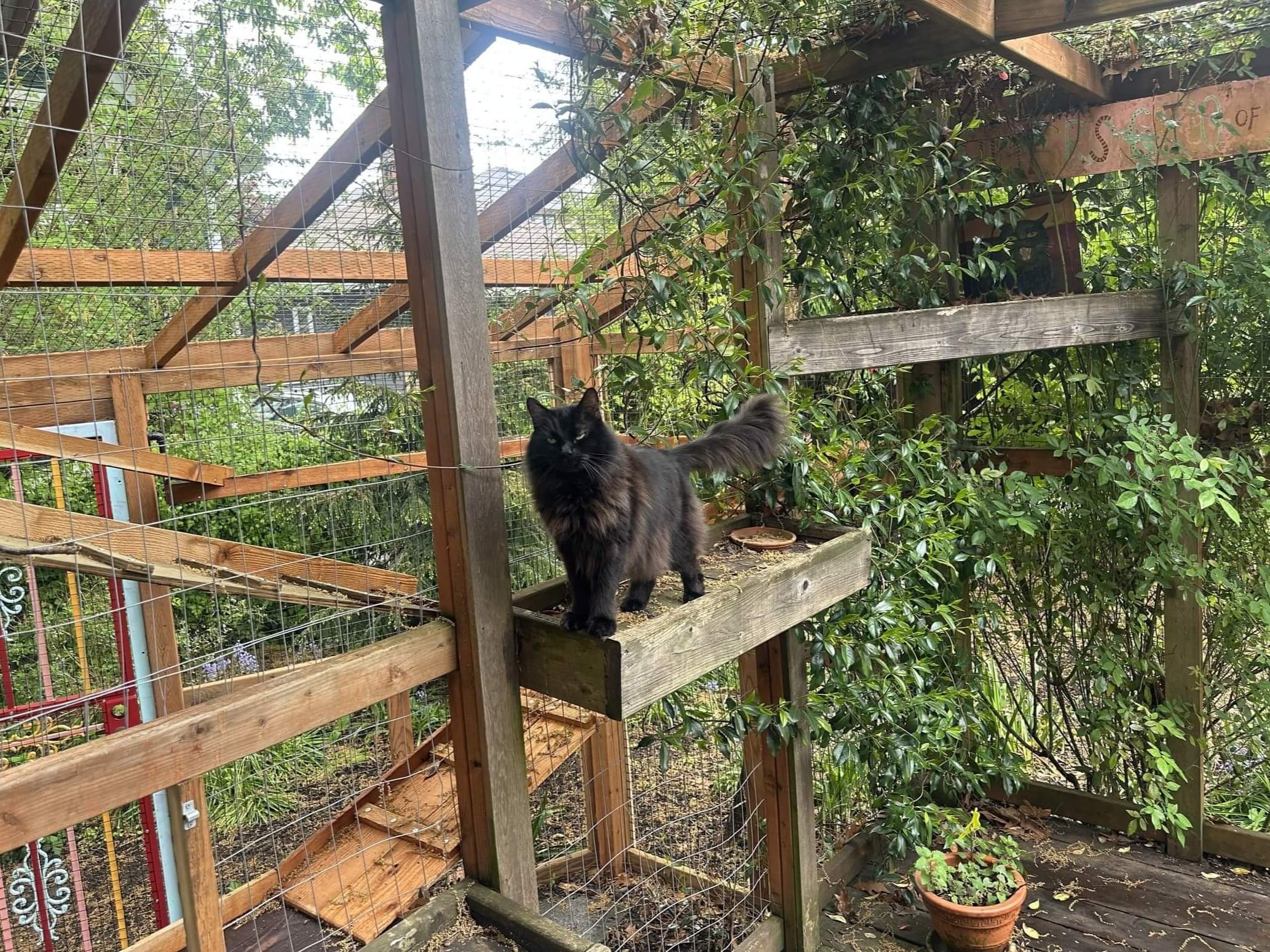
And so I adopted my first indoor cat. But not exactly. Because Lucifer has a fabulous catio.
What’s a Catio, and Why Do You Need One?
Catios are wire-enclosed areas where cats can safely spend time outdoors. They range from milk-crate-sized window boxes to wholly secured backyards complete with lavish furnishings and entertainment for both humans and felines.
Not only do catios keep cats safe from cars and coyotes, they also save songbirds and other critters from cats. And you could easily apply the old saying “fences make good neighbors” to catios: They keep cats from using the raised garden bed next door as a fancy litterbox.
Karen Kraus, who’s been the executive director of the Feral Cat Coalition of Oregon since 2002, built her first catio in the late 1990s, before the term “catio” was even coined.
What do feral cats have to do with cherished indoor darlings? “It was really clear that if we could keep cats from free-roaming, they wouldn’t become stray cats,” Kraus says. “They wouldn’t become the kitties that come into our services. They would be able to stay at home, and they’d be safe, and our local wildlife would be safe.”
But the core of Karen’s love for catios is personal. “I have had cats over the years that were 100% indoor kitties,” she says. “And I saw the relief that they seemed to experience being able to have outdoor time.”
Catios Are for People, Too
I spend almost every summer morning drinking coffee on a chaise lounge in our catio. While the sun rises, Luce watches squirrels from a high perch.
Other catio owners I know also report spending more time outdoors. Fellow Portlander Alex Boyd has a cat tunnel that runs along her deck banister. Her cats Wellington and Horatio sun themselves in the tunnel while she and her husband sit on the patio furniture just below. What started as a feline window box during the pandemic continues to expand both Boyd’s building skills and her appreciation of her backyard habitat.
Originally, Boyd put bird feeders in the garden to entertain her cats. “But then I got really into birding during the pandemic,” she says. “It’s fun for the cats to watch, but it’s also fun for me to watch.”
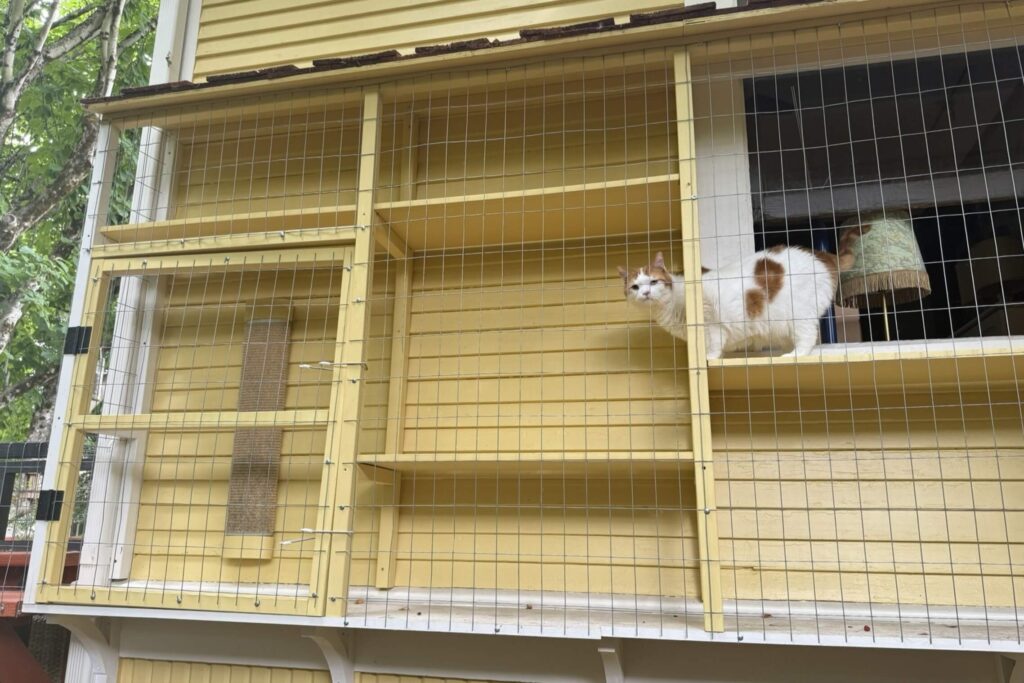
She’s even shifted her approach to gardening since developing an interest in birds. “I’ve been learning who’s here year-round, and who’s a seasonal visitor. What kind of seeds do they like, and how can I improve the habitat that supports them naturally?” She’s added a bird bath and native plants that feed birds over the winter.
Catio Best Practices
Cynthia Chomos, a Seattle-based feng shui consultant and designer who founded Catio Spaces in 2014, doesn’t want your catio to resemble a cage. “I want them to look like they’re a part of the house and that they complement and blend in with the garden and architecture,” she says.
The catio curious, Chomos says, should consider a few things before building. First of all, access: Will your cats enter their catio through a window or cat door? Second, sunny spots: Your kitty probably wants to do some sunbathing, so where will they be able to?
Chomos recommends that backyard catios be at least 8 feet tall with multiple cedar shelves and larger lounging areas at varying heights, as well as a human-sized door so that you can access your cat in case of emergency. If you don’t have that much space, she suggests building up. “Cats love vertical space,” she says.
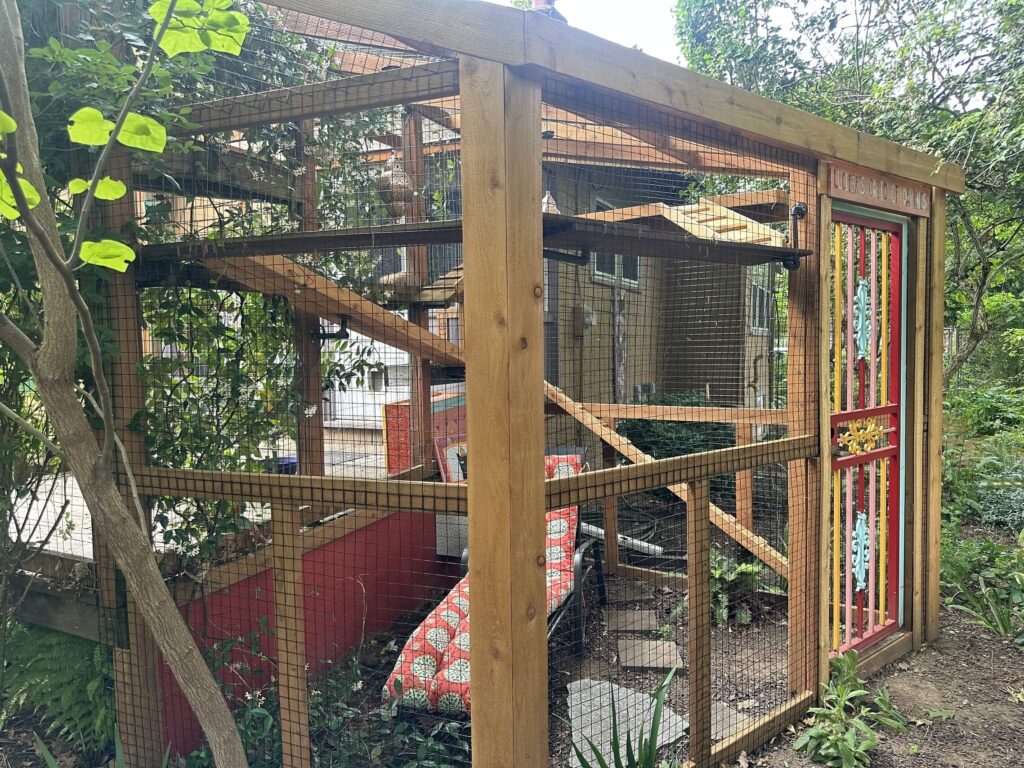
Lucifer’s catio includes many recycled materials, including repurposed brackets to hold up ledges, old cabinets I turned into brightly painted cubbies where Luce can escape the midday sun, and a recycled metal external security door that leads into the garden.
When it comes to the enclosure, Chomos recommends using bare, galvanized wire. I started with 2-by-4-inch wire, but after Luce stretched the wire and escaped during a cage fight with a neighbor’s cat, we switched it out to 1.5-by-1.5 inch wire. If you want a roof over your catio, you can maximize your cat’s views by choosing something clear rather than something opaque. Also, real grass and cat-safe plants beat artificial turf, which is a choking hazard, as well as being environmentally unfriendly.
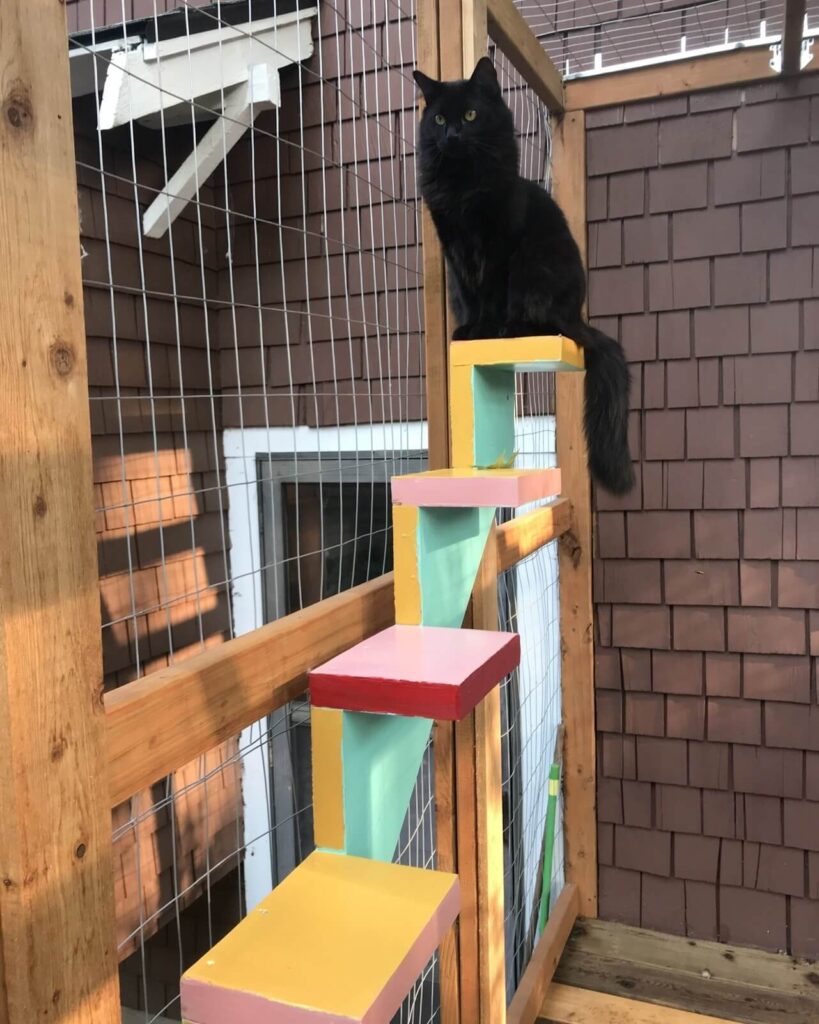
Once your catio is built, you can add special touches. Chomos suggests a spiral staircase, tunnels, a water fountain, even rugs. Luce’s Moroccan-style solar lanterns light his catio after dark.
If you’re looking for ideas on how to incorporate a catio at your house, you can check out Chomos’s catio design plans. You might also be able to take a tour of catios in your area — they’re offered in cities like Los Angeles, Seattle, and Portland.
There’s a tremendous joy factor for cat parents, knowing that their cats are out with the wind in their whiskers, and they’re taking in the sights and sounds, the stimulation of the outdoors.
– Cynthia Chomos, founder of Catio Spaces
I’m not a great housekeeper, decorator, or gardener, and I never expected to be on a home or garden tour, but I’m extremely proud that Lucifer’s Catio of Darkness has twice been featured on Portland’s catio tour, hosted annually by the Feral Cat Coalition of Oregon and the Bird Alliance of Oregon.
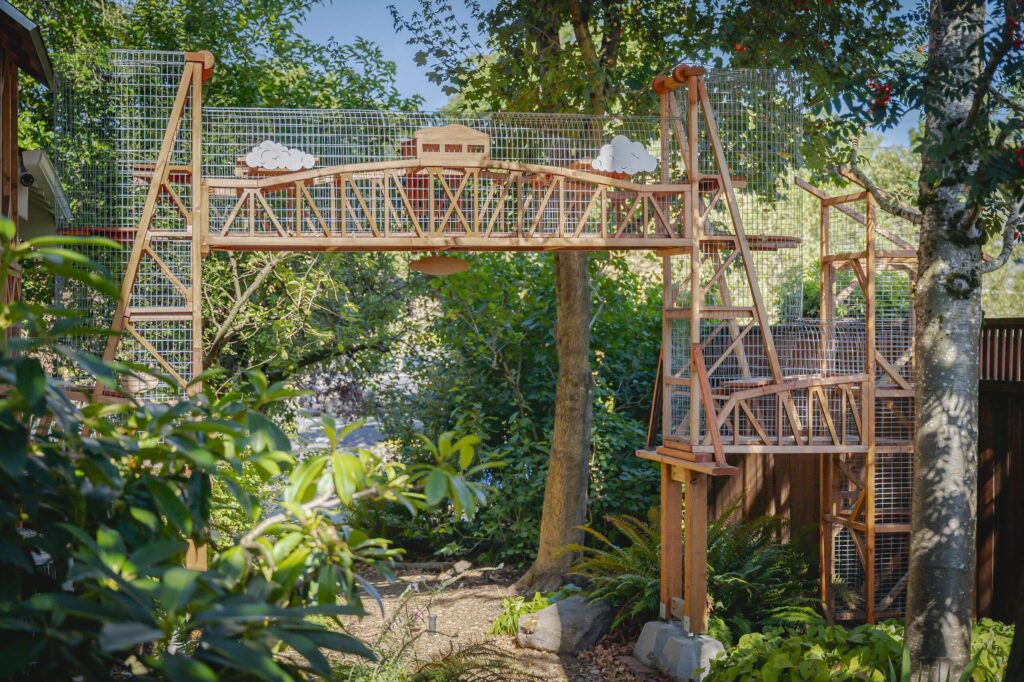
Two of the standouts in the 2026 Portland tour were a Japanese-style, teahouse-inspired catio complete with bamboo, and a catio featuring the Pawthorne Bridge — a cat-sized version of the city’s well-known Hawthorne Bridge.
The Joy of Catios
When I’m in the catio with Lucifer, I love watching his ears subtly change position as he registers every sound. “There’s a tremendous joy factor for cat parents, knowing that their cats are out with the wind in their whiskers, and they’re taking in the sights and sounds, the stimulation of the outdoors,” Chomos says.

Boyd has noted her cats’ satisfaction with their catio. “Wellington was always trying to escape out the front door when we would try to leave,” she says. “He doesn’t do that as much anymore because he knows he has his little space to enjoy.”
The catio movement is growing as people realize there’s a way to let cats be safe outdoors. Kraus believes our individual catios have wide-ranging effects on conserving wildlife.
“You might think, what does it matter in my backyard?” she says. “Well, it matters to your pollinators, all the way up to mammals. We can give a safe space for a bird to land, to rest in their migration.”
And, more selfishly, a place where we can safeguard our access to kitty cuddles.