

Note that if you purchase something via one of our links, including Amazon, we may earn a small commission.
Decoding B Corp, 1% for the Planet, and The Climate Label Certifications
I spent the better part of a decade working in creative strategy in the fresh produce industry, and I’m given to seeing fruit-related analogies everywhere. So today, in writing about sustainability certifications, I begin with berries. Once, I attended a marketing team meeting to review the packaging for a clamshell of heirloom strawberries. The lead designer had added the words “Gluten Free” to the label, and I threw a fit.
This would’ve been eight or 10 years ago, around the time that Vox declared “The gluten-free craze is out of hand.” Why, I asked our designer, would we point out that an inherently gluten-free item lacked gluten? Since when had any piece of raw, unprocessed, whole fruit ever contained gluten? The designer argued that gluten-free products were selling faster than ever before. This was absolutely true, I conceded. But that was no reason to clutter up the label, given how little room we had to convey how special these tiny, intensely fragrant strawberries were. Furthermore, the callout was likely to confuse consumers, and make them wonder if fruit could contain gluten. Eventually, the company VP joined us, and I won the battle of the Mara des Bois strawberry package.
Let’s talk about sustainable seals of approval.
There’s been a big uptick in the number of labels and certifications available for products over recent years. In theory, these words and symbols guide consumers as they search for berries, leggings, mattresses, food-storage containers, paint, and so much more. In practice, their meaning isn’t always clear.
Today, I want to talk you through three sustainability certifications you’re likely to encounter. These are 1% for the Planet, B Corp, and The Climate Label (formerly known as Climate Neutral Certified). I’ll give you an overview of what these certifications mean, and tell you about a few companies that boast at least two of the three. One thing to remember, however: Don’t necessarily write off a brand if these certifications are absent. But more on that later.
1% for the Planet
I’m proud to tell you that Bluedot Living is a 1% for the Planet member. That means that we donate at least 1% of our annual sales directly to environmental organizations. Over 4,800 other companies across 110 countries do the same. The 1% for the Planet folks certify every donation.
Here at Bluedot, our donations help support The Bluedot Institute and the Environmental Defense Center. Created in 2021, the Bluedot Institute is an affiliated non-profit public benefit corporation. The Institute is dedicated to inspiring future climate leaders by supporting students and their teachers in creating local, solution-oriented environmental projects. The Environmental Defense Center is a non-profit public interest law firm that was established in response to the 1969 Santa Barbara Oil Spill. The EDC focuses on protecting California’s coast and natural environment in the area from Los Angeles to San Francisco.
If you’re interested in finding companies that contribute to 1% for the Planet, you can search the directory. Each company page gives you information about the brand and shares which organizations the brand contributes to. Since 2002, 1% for the Planet members have given more than $784 Million to environmental causes.
B Corp: An Introduction
Essentially a stamp of good corporate citizenship, B Corp Certification measures “a company’s entire social and environmental impact.” B Corp states that the certification shows “that a business is meeting high standards of verified performance, accountability, and transparency on factors from employee benefits and charitable giving to supply chain practices and input materials.”
To become a Certified B Corp, a company must go through a 13-step process that can take months or years — and receive a total score of 80 points or higher on the B Impact Assessment created by B Lab Global, the non-profit that verifies the assessments and certifies B Corps. (Per B Lab, the median score for businesses is 50.9., well short of the 80 points that would be needed to achieve certification.) Companies that achieve certification must then recertify every three years. The assessment assigns scores for Governance, Workers, Community, Environment, and Customers. Around 9,500 companies worldwide are B Corps, about a third of those in the U.S.
Changes at B Corp?
You can easily search for B Corps. (I have that page bookmarked in my browser and like to nerd out by looking at B Corp assessments. But that’s probably just me…). While I haven’t been able to find a breakdown of averages, most companies seem to score under 100. Anything over perhaps 120 really makes me take notice. Bluedot favorite Dr. Bronner’s has the highest B score of all: 206.7. However, the soapmaker won’t be a B Corp for long.
Earlier this year, Dr. Bronner’s announced that it will not seek recertification, “citing weak standards that enable greenwashing and purpose-washing by multinationals.” Per the release, “The increasing certification of multinationals including Unilever Australia and Nespresso in 2022 followed by Nestle Health Sciences in 2023 demonstrated that B Lab is not committed to protecting the integrity of the B Corp Certification and movement, nor ensuring that the certification won’t be used to mislead consumers. Sharing the same logo and messaging regarding being of ‘benefit’ to the world with large multinational CPG companies with a history of serious ecological and labor issues, and no comprehensive or credible eco-social certification of supply chains, is unacceptable to us.”
Whether or not other purpose-driven companies will follow Dr. Bronner’s remains to be seen. I wouldn’t bet on it: 51% of American adults under 39 and 36% of American adults overall are familiar with B Corps and more likely to make purchases from certified companies.
The Climate Label (formerly Climate Neutral Certified)
If you see The Climate Label stamp on a product, it means that a company has measured and publicly disclosed its greenhouse gas emissions, set an internal price on emissions and invested that amount into climate solutions verified by the The Change Climate Project, and more. Before adding the label to its website or branding, a company must first offset at least a full calendar year’s worth of emissions. Some brands go further by offsetting emissions from earlier years as well.
The certification originated in 2019. The founders of two brands, Peak Design and BioLite, launched a nonprofit called Climate Neutral to help brands measure and account for greenhouse gas emissions. Climate Neutral created a certification, Climate Neutral Certified, to aid consumers looking to make climate-conscious choices. It also gave brands like theirs a way to stand out. The certification meant that companies had measured their entire carbon footprints, purchased third-party verified carbon offsets, and committed to reducing emissions over time.
Early adopters like Allbirds embraced the stamp as a signal of accountability, and hundreds more brands followed. But as claims of carbon-neutrality proliferated and scrutiny around offsets increased, the Climate Neutral team decided to increase its standards. In 2023, the organization rebranded as The Change Climate Project. In January 2025, it began issuing certifications with a new name: The Climate Label.
The updated framework moves beyond offsetting and toward more financial investment in decarbonization. Under the 2025 Standard, certified companies must still measure their emissions. They're now also also required to set an internal carbon price and spend that amount on climate solutions.
The minimum carbon price a company can set is $15 per ton. A company with 1,000 tons of measured greenhouse gas emissions, for example, would be compelled to spend at least $15,000 on emissions reductions solutions approved by Change Climate Project. Those solutions could include improving operations, redesigning supply chains, or investing in carbon removal. According to The Change Climate Project, the idea is to “align the true cost of pollution with the dollars companies put toward solving it.” Over 270 brands have The Climate Label certification.
What Does It All Mean?
These certifications — 1% for the Planet, B Corp, and The Climate Label — can be useful tools for consumers looking to shop more sustainably. Each one signals that a company has invested time, money, and effort toward environmental or social responsibility. Any brand that has all three has put substantial effort into its sustainability program, as well as into being perceived as sustainable.
While none of the certifications is wildly expensive, the associated processes do require a real investment of time and resources. That can be especially tough for small or early-stage companies. As I mentioned above, I don’t see the lack of these certifications as a mark against a company. Some of the best brands we’ve come across don’t have them. That's not because they don’t meet high standards, but because they’re focused on making products, not filling out paperwork. Or, they may have other certifications not mentioned here.
Furthermore, certifications don’t present a complete picture. A pet peeve of mine is seeing a brand that has lots of sustainability certifications, yet chooses to use plastic packaging for cosmetics that could be packaged in glass or paper. Or one that only sells small sizes and doesn't offer refill options.
When choosing brands for inclusion in Bluedot’s BuyBetter Marketplace, we always consider (and verify) certifications. But we also look beyond these, towards ingredients, materials, packaging, labor, how a company engages with its community, and more. Certifications can be helpful shortcuts, but they’re not the only way to demonstrate values. They also don’t guarantee a company is doing everything right. Case in point: Dr. Bronner's, which has exceptional sustainability standards, is stepping away from B Corp certification to protest what it sees as weakened standards.
Hopefully, this newsletter gives you a better understanding of how some of the top certifications work. We also hope it helps you see how we use them — and look beyond them — when choosing companies to feature. We’d love to hear from you, too: What do you look for when you’re shopping? What tells you that a brand aligns with your values? You can always reach us by emailing marketplace@bluedotliving.com.
Companies With Great Pedigrees

Ettitude Bedding and Home
B Corp, 1%, Climate Label – Ettitude rethinks luxury bedding with its signature CleanBamboo fabric, made in a closed-loop system with non-toxic solvents. Last year, Ettitude achieved a 55% year-over-year reduction in carbon dioxide emissions by reducing the number of items in its collection overall even as the company has continued to grow. We commend Ettitude for offering a streamlined assortment with fewer seasonal offerings. Ettitude has a B Score of 123.3.

Bambu Home
B Corp, 1%, Climate Label – Bambu Home makes kitchen and dining products from, you guessed it, bamboo! The proudly woman-owned brand keeps a close eye on sourcing, labor, and durability. Bambu gives back to organizations including the World Wildlife Fund and The Nature Conservancy, has reduced emissions by ceasing all air freight, and has a B Score of 111.

Peak Design
B Corp, 1%, Climate Label – Peak Design makes functional, sustainable tech accessories including bags, backpacks, travel gear, and phone and camera accessories. As a founding member of Climate Neutral, the company has already set — and achieved — many climate-related goals. Currently, it is shifting to using only recycled aluminum across its products. The brand gives to groups including Adventure Scientists and The Conservation Alliance, and has a B Score of 106.4.
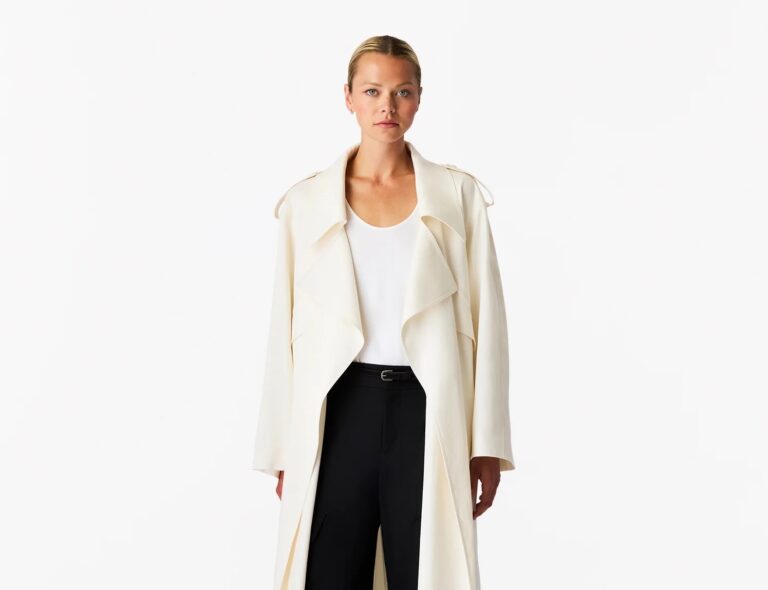
Another Tomorrow Apparel
B Corp, 1%, Climate Label – Another Tomorrow apparel does more than design beautiful clothes. The New York–based brand is “using fashion as a pathway to activism,” and says that “every decision has been guided by a value system based on three pillars – human, animal, and environmental welfare.” The brand has a B Score of 93.8 and emissions reductions goals including switching to regenerative organic cotton.

Patagonia
B Corp, 1% – Many of us think of Patagonia as the gold standard in sustainable clothing. It may come as a surprise, then, to learn that Patagonia doesn’t call itself a sustainable brand. With a B Impact Score of 166, Patagonia ranks among the highest-performing B Corps in the world. Long before “sustainable fashion” was a buzzword, the brand began giving back to grassroots organizations and pushing for regenerative sourcing, environmental justice, and corporate responsibility.
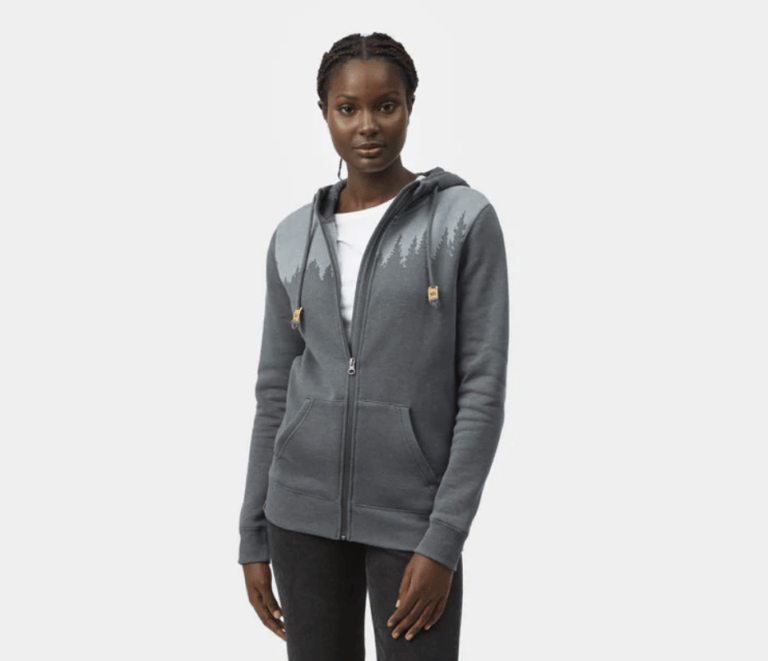
TenTree
B Corp, The Climate Label – British Columbia–based Tentree makes comfortable basics and activewear, planting ten trees per item sold. The brand works toward circular fashion and climate action through sustainable textiles and transparent impact reporting, and current climate goals include increasing the number of deliveries made by electric vehicles. A Certified B Corp since 2016, Tenree has a B Score of 136.2.

Nimble Tech Accessories
B Corp, The Climate Label – Nimble makes tech accessories like charging cables, power banks, and phone cases using recycled plastic, aluminum, and other low-impact materials. The brand offers plastic-free packaging and a free e-waste recycling program to help close the loop on tech waste, and recently met a goal of reducing the weight of packaging per product by 20%. Nimble has a B Impact Score of 91.
If you’d like to learn more about what it means to be a B Corp from the business perspective, read this interview Bluedot Living reporter Lucas Thors conducted with James Anthony, the President of Martha’s Vineyard Bank, Massachusetts’s only B Corp bank. It also happens to be Bluedot Living’s bank! The company has a B Score of 103.7.
