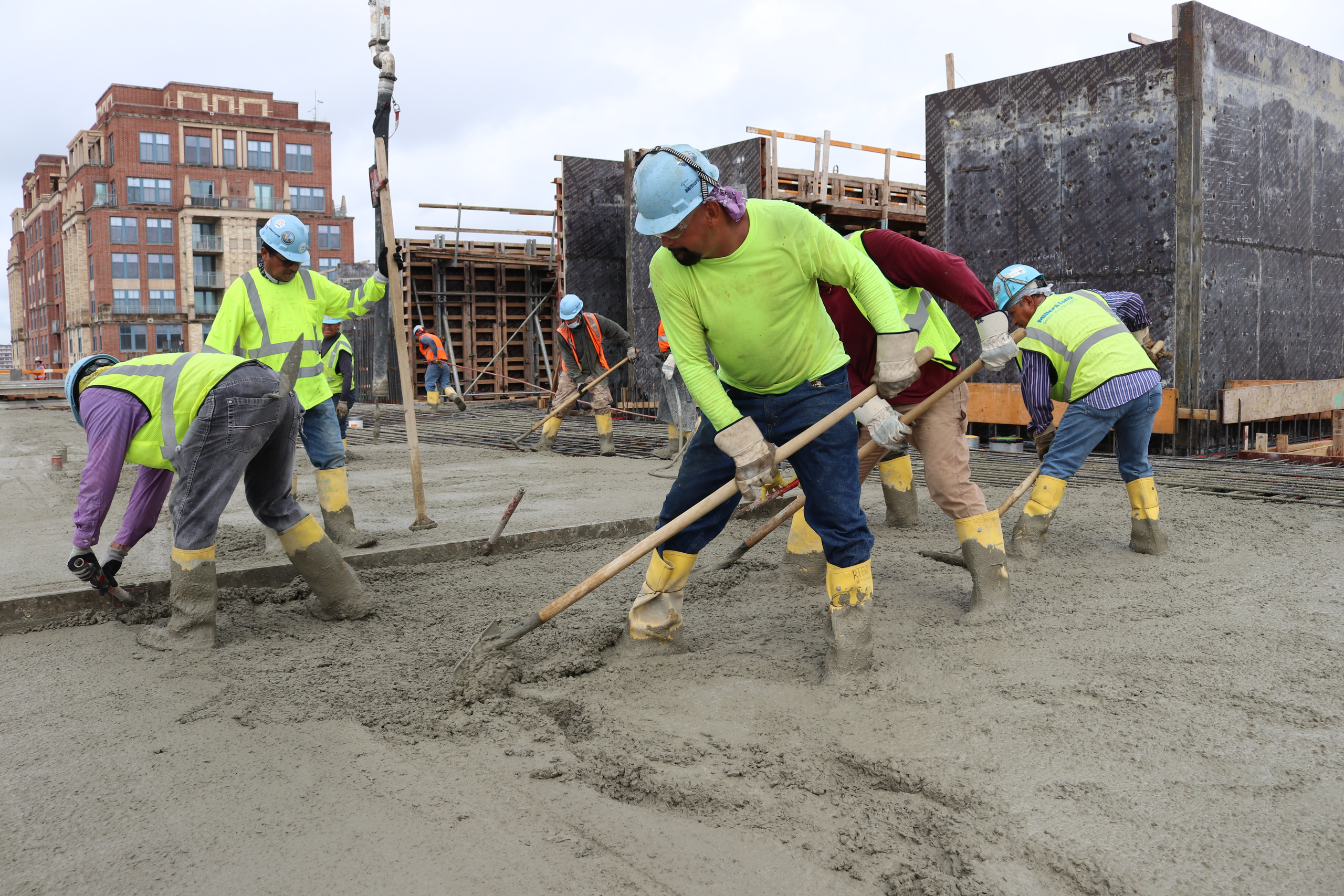
If concrete were a country, it would be the world’s third-largest carbon emitter. The challenge? To create a product that is as strong, durable, and easy to work with as concrete. And, of course, it can’t cost more.
Humans have been using concrete, or some version of it, for thousands of years to construct homes and other buildings, roads and sidewalks, bridges, dams, canals, airport runways, and countless other structures that support and give shape to human lives and activities. It’s the most-used building material on earth because it’s easy to work with, fire-resistant, waterproof, incredibly strong, and long-lasting. Civilization as we know it would not exist without concrete.
Concrete’s Dirty Secret
But there’s a downside to concrete that can’t be ignored: making it generates massive amounts of carbon dioxide. The culprit is not the concrete itself but Portland cement, the fine powder that, when mixed with water, hardens and glues together the sand and gravel that are concrete’s other primary components.
Every year the concrete industry cranks out as much CO2 as all of India and accounts for roughly eight percent of global carbon emissions. The bulk of this comes from the manufacture of Portland cement, of which some four billion tons per year are produced.
To make Portland cement, limestone is quarried and crushed, mixed with ingredients such as clay, and fed into a kiln, a steel cylinder that can be up to 650 feet long and wide enough to drive a car through. The kiln is tilted at an angle, spins slowly, and is heated to temperatures as high as 2,700°F. Inside the kiln, the limestone decomposes into carbon dioxide and calcium oxide (commonly known as lime). The lime is mixed with silica, aluminum, and iron, and tumbles out the other end of the kiln in the form of marble-sized dark gray balls of artificial rock called “clinker.” Once cooled, the clinker is crushed to make cement.
Carbon dioxide is an unavoidable by-product of the chemical reaction that creates lime. It’s also generated by the energy sources — often coal- or natural-gas-fired plants — used to run the plant and heat the kiln. As a result, every year the concrete industry cranks out as much CO2 as all of India and accounts for roughly eight percent of global carbon emissions. The bulk of this comes from the manufacture of Portland cement, of which some four billion tons per year are produced. If concrete were a country, it’s often noted, it would be the world’s third-largest emitter, behind only China and the United States. Most concrete-related emissions come from China, where the use of the material dwarfs that of all other countries because the country is still building out the roads, bridges, apartments, and office towers that most of the developed world built in the last century.
The concrete industry is aware of its outsized contribution to global CO2 emissions. As a result, scientists and engineers at companies and universities around the world are working hard to find new ways to reduce or eliminate the sector’s carbon footprint. The challenge is to create a cement that produces concrete that’s just as strong, durable, and easy to work with as concrete made with traditional Portland cement. And, of course, it can’t cost more.
The experts say that no single magic bullet will help cement producers to reach this goal. Rather, a combination of solutions including energy efficiency and low-carbon fuels in cement production, the use of cement additives that decrease or eliminate the amounts of Portland cement in concrete, and technologies such as carbon capture and sequestration, offers the best chance to get there.
Replacements for Cement
For decades, producers have been adding industrial by-products to Portland cement like fly ash (a waste residue produced by coal-fired power stations), steel blast furnace slag, calcined clay, and — especially in Europe — crushed limestone. Making one ton of traditional Portland cement creates one ton of CO2, so the less pure Portland cement there is in each ton of concrete, the lower the concrete’s embedded CO2 (the total amount of carbon released during the manufacture of a material).
Terra CO2 Technology, based in Golden, Colorado, is developing a way to make other supplementary cementing materials (SCM) — additives or replacements for cement — from silicate-based rocks like granite, basalt, and sand, which contain no carbon and are widely available around the world.
Unfortunately, the first two workarounds have a limited shelf life. As part of global carbon-reduction efforts, the dirty coal-burning plants that produce fly ash and the blast furnaces that create slag as a by-product are being phased out and replaced with power sources such as electric arc furnaces and alternative production techniques. That means that supplies of fly ash and slag will decline — and become more expensive.
But other materials besides fly ash and slag can fill in for pure Portland cement. Replacing some of the clinker with crushed limestone can reduce the carbon intensity of Portland cement by ten percent. “Portland limestone cement,” or PLC, is commonly widely used in Europe, but US concrete producers are comparatively late to the party, having just begun to embrace it in the past few years. Despite its late adoption, PLC has captured roughly a third of the US concrete market.
But crushed limestone isn’t the only Portland cement replacement game in town. Terra CO2 Technology, based in Golden, Colorado, is developing a way to make other supplementary cementing materials (SCM) — additives or replacements for cement — from silicate-based rocks like granite, basalt, and sand, which contain no carbon and are widely available around the world. In Terra’s process, these materials are turned into a glassy powder that can replace up to 40 percent of the Portland cement in concrete. If the kiln is heated using renewable energy sources to melt the rock, Terra’s process generates zero CO2. The company says its production facilities, the first of which is now being built in Texas, can be set up close to sand and gravel quarries and concrete plants that serve local markets. The company estimates that every ton of cement replaced by its SCM product lowers emissions associated with concrete production by 70 percent.
Then there’s Sublime Systems, another hot startup that’s figured out how to make cement in a way that sidesteps the need for energy-gobbling kilns altogether. Like Terra, the company uses lime and silicate rocks as feedstock. But instead of heating them to volcano-like temperatures, it uses an electrochemical process to break them down at room temperature to make the ingredients of Sublime’s final product, a cement that both contains no carbon and whose manufacture doesn’t produce carbon.
These technologies and others have proven their utility in various experiments and small-scale pilot projects that don’t involve large quantities of cement. Right now, Sublime can make about 100 tons of its cement annually, but it’s just broken ground on a new commercial plant in Holyoke, Massachusetts that’s projected to open in 2026 and produce 30,000 tons per year. Terra CO2 says its Texas plant will produce 240,000 tons of its cement additive per year. But a modern Portland cement plant cranks out more than a million tons of product per year and can cost more than a billion dollars to build. The next step for the likes of Terra and Sublime, then, is to gain industry acceptance and attract enough funding to build plants that enable their solutions to be rolled out on a far more massive scale. This will be a formidable challenge, as the construction business is competitive and often cautious about adopting new ways of doing things they suspect might slow building projects down or cost more money.
Carbon Capture and Sequestration
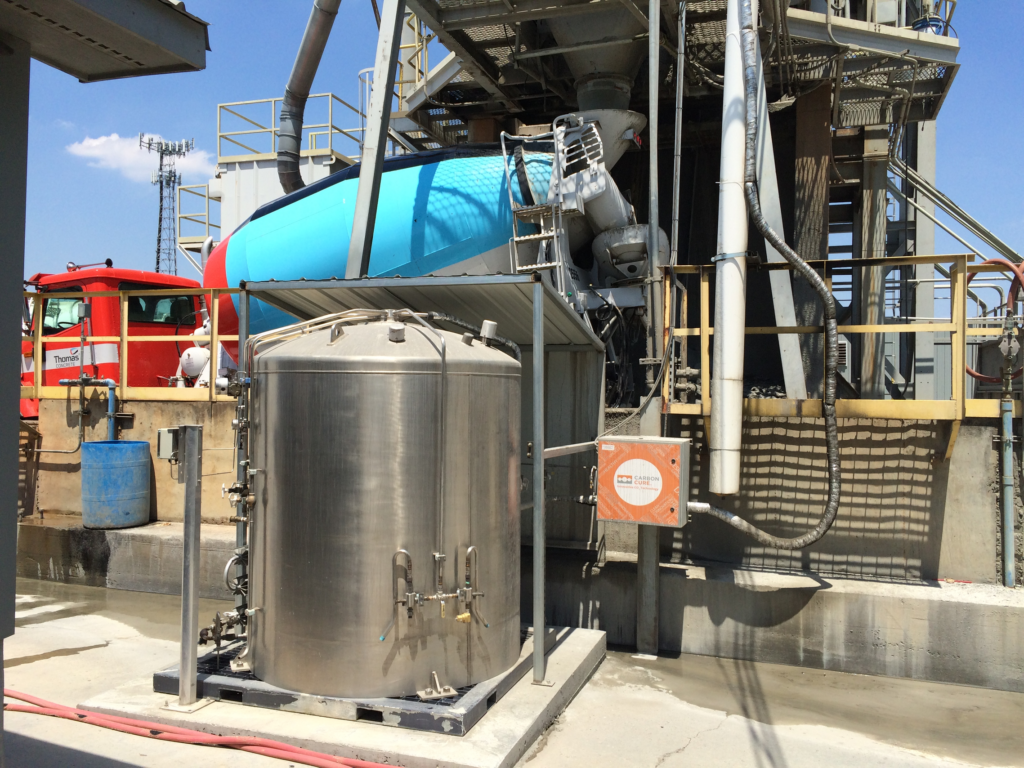
It’s also possible to embed CO2 within concrete, an approach touted by Halifax-based CarbonCure Technologies and CarbonBuilt in Los Angeles. These companies have separately developed systems that allow concrete producers to inject waste CO2 from industrial sources directly into the concrete while it’s being mixed. When CO2 is injected into wet concrete, it reacts with the calcium ions in cement to form a mineral called calcium carbonate, which becomes a part of the concrete. This mineralization process improves the concrete's compressive strength, speeds up the curing time, and allows producers to use less cement in the mix, further reducing the concrete's carbon footprint.
In 2021, CarbonCure and CarbonBuilt shared the grand prize in a prestigious global competition for innovations that convert CO2 emissions into useful products. Today, CarbonCure’s carbon injection units are being used in more than 300 concrete plants worldwide. Meanwhile, in May, an Alabama concrete plant began using CarbonBuilt’s technology to produce the world’s first ultra-low carbon concrete blocks. But some concrete experts are skeptical about carbon injection and say the same benefits associated with the technique — mainly, stronger, greener concrete — can be obtained simply by optimizing the mix of cement additives.
Many industry experts say another response to cement’s CO2 problem is underground storage of the carbon dioxide generated during the Portland cement production process, a technique known as carbon capture utilization and storage (CCUS). For example, a Norwegian cement plant captures and liquefies the CO2 coming out of its plant’s smokestack. The liquified CO2 is transferred to pressurized tanks and transported in special ships to another facility that pumps the liquid CO2 almost two miles (three kilometers) underground in the North Sea, where the gas will remain sequestered, presumably forever. Texas-based Heidelberg Materials, a major global building materials and cement manufacturer, is building the world’s first full-scale CCUS solution at its cement plant in Edmonton, Alberta. Slated for completion in 2026, Heidelberg says the $1.4-billion plant will capture more than one million tons of CO2 annually and store it underground. The obvious downside to CCUS is that it’s incredibly expensive. Also, much of the CO2 cleaned from cement plants for CCUS is pumped into aging oil wells to help fossil fuel companies recover more oil. Many environmentalists believe pumping CO2 into the ground to obtain more fossil fuels — the burning of which caused the climate crisis in the first place — is a questionable practice at best.
No Quick Fix
No one knows which of these approaches to decarbonizing cement will achieve widespread commercial success and help make the ambitious net-zero–by-2050 goal touted by the Global Concrete and Cement Association a reality.
Cementing Change
Companies in the building technology space are catching wind of this shift. Mighty Buildings, a 3D printing construction company from California, has partnered with Fortera, a materials technology company that produces eco-friendly cement. Fortera's eco-friendly cement reduces harmful carbon pollution by 60% compared to traditional cement.