Banks are climate bad guys, right? Not at century-old Amalgamated Bank, where they think it’s high time they bet on our planet’s health.
Conceived in 1923 by the leader of the Amalgamated Clothing Workers of America, Amalgamated Bank was created to provide a safe place for workers — often immigrants — to put their money and have access to financial products and services that they might otherwise be denied, including unsecured loans and a foreign exchange service to securely send money to family in their home countries.
Amalgamated is celebrating its centennial this year, and Ivan Frishberg, the company’s sustainability officer, says that while much of the company’s philosophy remains the same — a desire to help those often on the margins — “The issues we face now versus what we faced 100 years ago are just different.”
Specifically, the company has been considering how it might address the climate crisis.
It was 2016 when those working for the bank realized just how different the issues it faced had become. “Trump was winning and making a very early commitment to pull out of [the] Paris [Climate Agreement],” Frishberg explains. “So a lot of our conversation was about defining what it meant to still be in Paris.” Using the clear set of goals enumerated in the Paris Agreement, Amalgamated considered what it meant, as a bank, to also contribute and commit to those goals. “The first thing we did was look at the impact of what we did — our first greenhouse gas inventory,” Frishberg explains, which included a commitment to be net zero in the company’s operations starting in 2017.
The company examined its own contribution to carbon emissions from its finance portfolio — the financed emissions of a bank are about 700 times the operational emissions, Frishberg says, so “the number one thing we can do is figure out how to measure and manage the emissions that come out of our portfolio.” To manage its financed emissions, the bank began moving its portfolio toward climate solutions. Since then, about a third of the bank’s lending has been focused on sustainability, including providing lines of credit for home solar installations and commercial lending for utility grade battery storage facilities, microgrids, and biodiesel derived from food waste.
Outside of that third, climate still plays a role, Frishberg says, as when the bank seeks out residential or commercial building projects that are guided by sustainability and resilience. Consequently, he says, “We have a much safer and sounder balance than we did. “It’s [also] a more … profitable bank.”
And besides being good for the bottom line, Frishberg says, these climate solutions “create jobs, cleaner jobs, often higher paying jobs.”
But Amalgamated isn’t just focused on where they invest; they also pay attention to where they won’t, such as private prisons, gun manufacturers, mining, Payday lending, and various fossil fuel initiatives.
The bank began moving its portfolio toward climate solutions. Since then, about a third of the bank’s lending is focused on sustainability, such as lines of credit for home solar installations, as well as commercial lending for utility grade battery storage facilities, microgrids, and biodiesel derived from food waste.
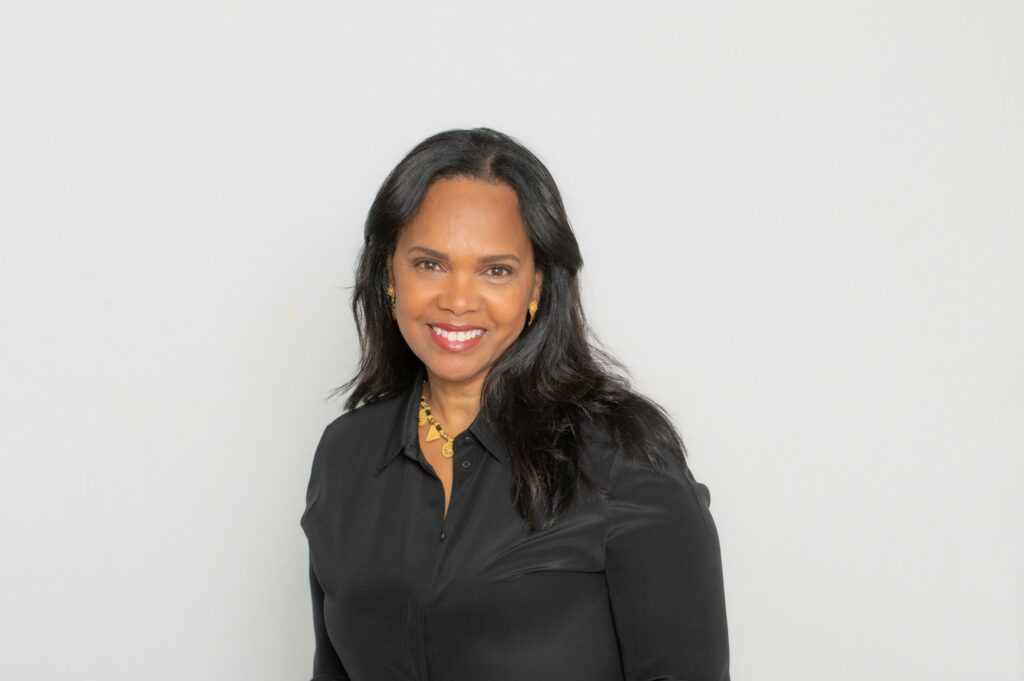
Priscilla Sims Brown, hired in June 2021 as Amalgamated’s CEO, told us she was attracted by its commitment to social issues, including climate. Sims Brown, who’s Ethiopian American, has lived in India and Australia (among other global hot spots), and it’s clear, she says, that climate is affecting the most vulnerable communities. Amalgamated, she adds, allows her to have some impact. “We think about the intersection of climate and vulnerable communities,” she explains. “We ask the questions around sustainability — if we’re doing an affordable housing project, for example. That would not be counted as a sustainable project for our reporting purposes. But it does enable us to help others … fully understand the intersections between [that] and climate.” Those intersections — between what’s good for human beings socially and what’s good for the climate — refer to the fact that climate change and environmental degradation have particularly negative impacts on low-income people. Increased heat, for example, is correlated with increases in gun violence. Fewer trees are planted in many low-income communities, resulting in higher than average temperatures. Low-income neighborhoods are also more likely than wealthy ones to abut highways and plants spewing noxious emissions, exposing residents to high levels of pollutants. For these and other reasons, Amalgamated keeps social justice concerns in mind as part of its climate-oriented investment strategy.
While proud of how Amalgamated “punches above its weight,” Sims Brown is charitable about the dismal records (my words) and “challenges” (her word) of so many of the larger banks. While well-known climate writer and activist Bill McKibben is unflinching in his criticism of large banks’ funding of fossil fuel projects — having made divestment a pillar of his activism — Sims Brown considers it a “luxury” at Amalgamated to have “my board, my customers, my employees all aligned around this. Even our investors, most of them are aligned.” Indeed, she says, Amalgamated’s stakeholders expect this kind of leadership from the bank. Consequently, Sims Brown says, Amalgamated can act as something of an example to other banks — “should they choose to, and we certainly encourage them, if they want to move away from fossil fuels, to have the pathway to do so. We see that as our role.” Shifting away from fossil fuels has corresponded with an expanded roster of investments at Amalgamated, and within the newer investments, the percentage of investments in what the bank calls “the highest positive impact sectors” has also increased.
Fortunately, what Sims Brown calls “doing well by doing good” (for example, funding commercial and residential clean energy programs) has been a win-win strategy. “There are projects that have been highly profitable for banks [and] very, very impactful — enabling low and moderate income individuals to have access to solutions that they wouldn’t normally be able to finance or pay for directly. Everyone ought to have access to solutions that … enable them to make their homes more resilient and participate in the broader solutions around environment.”
But climate, as Sims Brown insists, has to consider many other intersections, from racial injustice to wealth inequality to gun violence. To address these issues:
- Amalgamated led the way in advocating for a merchant code from the International Standards Organization to help gun sellers detect suspicious activity related to guns or ammunition purchases. The code was approved in fall of 2022.
- Amalgamated was the first bank to endorse Everytown for Gun Safety’s principles for responsible practices for gun manufacturers and distributors. The bank will not lend money to gun, nuclear weapon, or ammunition manufacturers or distributors.
- The bank will reimburse employees who need to travel out of state to access reproductive healthcare.
- Amalgamated is the first U.S. bank to endorse HR40, a bill establishing a Commission to explore reparations for African Americans.
Sims Brown takes cues from the “impatience of young people,” she says. “We need them telling us to hurry up. The problems won’t get solved if we move at the pace in the future that we’ve moved in the past.”