Miracles at Martha’s Vineyard Mycological
The New York Times recently named mushrooms “Ingredient of the Year” for 2022 and an essential food for the plant-based movement.
The woodsy “umami” or savory flavor of mushrooms make them a natural and satisfying substitute for red meat, and demand has been growing. Most commercial mushrooms are grown indoors, but those being grown in operations outside in woods and forests are being hailed as both nutritionally superior and with even fewer impacts on the environment. The island of Martha's Vineyard has one of the largest and most successful log operations in New England and, possibly, the country.
When you walk around Martha’s Vineyard Mycological farm in the woods of Chilmark, you know it’s a different kind of agriculture. MVM grows shiitake mushrooms — a prized Japanese mushroom known for its medicinal qualities and flavor — on hundreds of 4-foot oak boughs in row after row, leaning upright against rails under a large shade canopy. They don’t require irrigation or soil, fertilizer or feed — making these mushrooms significantly less environmentally impactful than animal proteins.
“The Vineyard’s unique ecology makes our mushrooms the most efficient form of local protein both in land and water use,” says Truman French, who started the farm in 2015 with Tucker Pforzheimer after the pair met in a mycology class at Harvard University. Both were studying something different, and did not expect their futures would involve a farm of stockpiled wood and deliveries of mushrooms to dozens of chefs and markets. They utilize only three outdoor acres to produce thousands of pounds of protein per season.
“We have everything we need to produce this here; it makes sense to have this be an Island food, like venison, scallops, or lobster,” says Pforzheimer. “We were passionate about creating an elegant business that fits its location.”
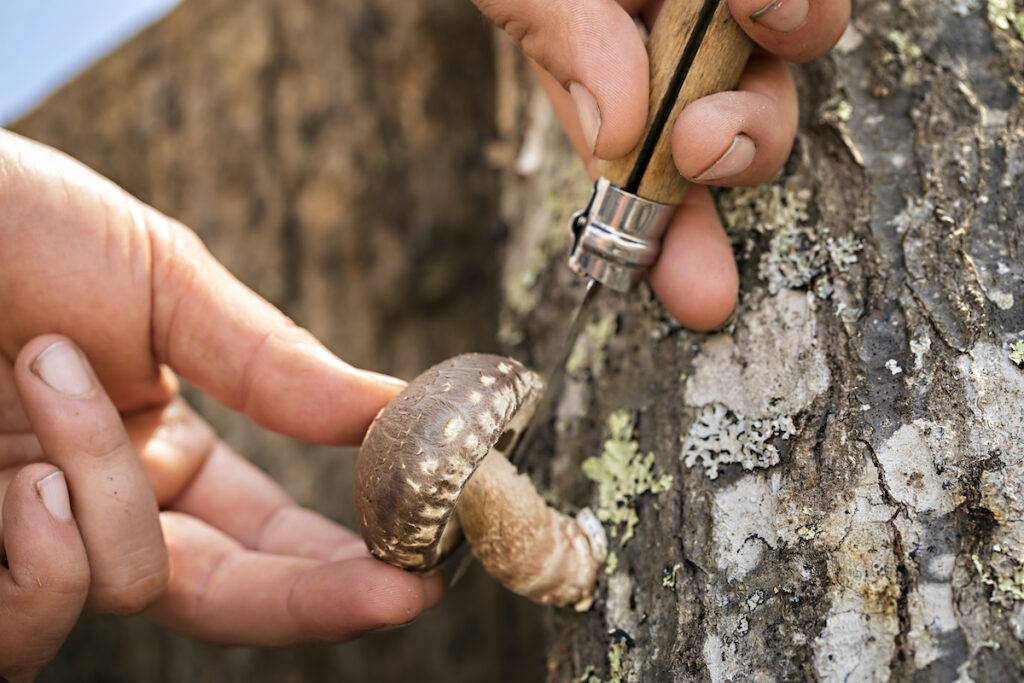
Shiitake, meaning “oak mushrooms” in Japanese, is the second most produced mushroom in the world, following the common button mushroom. French and Pforzheimer draw on the authentic Japanese growing methods on natural oak logs, where the mushrooms feed on the minerals and complex sugars in the oak itself, increasing nutrients, fiber, protein — and the flavor as well.
Shiitakes have been grown this way in Japan traditionally for generations and command a good price on the market, says Dr. Ken Mudge, a professor emeritus of horticulture at Cornell University, who researches and teaches courses on forest farming and mushrooms. A few years back, Mudge led a project in conjunction with the Center for Sustainable Agriculture at the University of Vermont to train forest owners in shiitake production that drew nearly 100 participants. Other specialty mushrooms, such as lion’s mane, oyster, and wine cap can be grown successfully outdoors, says Mudge, but only log-grown shiitakes can be grown consistently enough to supply the market. This is due to the unique ability shiitake logs have to be soaked or “forced” to fruit by being immersed in water for 12 to 24 hours, which stimulates fruit production.
Mudge wrote the groundbreaking Farming the Woods about growing food and medicinals in forests with co-author Steve Gabriel, a mushroom educator at the Cornell Small Farms Program and a mushroom grower himself at Wellspring Forest Farm in New York. Gabriel grows lion’s mane and oyster mushrooms at his farm in a solar-powered greenhouse and shiitakes outside on logs, and offers a mushroom CSA. “Mushrooms are absolutely the protein source with the lightest ecological footprint,” Gabriel says. He has taught thousands about the ways farming and forestry can be combined to both benefit the ecology and economies of small farms. The pair has helped establish a mushroom resource center at Cornell to provide research, training, support, and online training for both mushroom enthusiasts and those who are considering a business. Cornell also maintains a food forest farm on campus.
“Mushrooms are absolutely the protein source with the lightest ecological footprint,” Gabriel says. He has taught thousands about the ways farming and forestry can be combined to both benefit the ecology and economies of small farms.
“The trends are skyrocketing; there’s a ton of interest in it,” Gabriel says. Ten to fifteen years ago, there were no mushroom farmers in the area, he says, and now he knows of about 100 other mushroom farms in the state of New York, where he lives, and a good number in Vermont. Most have 1,000 to 2,000 logs in production. “I think it’s still an emerging field,” he said. “People are still learning how to do it well.”
Mudge says it’s important to him that mushroom log production allows forest landowners an additional way to make money off their forest and thereby sustain the land. But this type of farming is labor intensive, he notes. “It’s a superior product and an opportunity for people to put a wood lot to good use, but it’s a lot of work, a lot of lifting. You have to be very serious.”
MVM knows this well, with 45,000 logs in production producing about 15,000 pounds of mushrooms yearly. MVM works with Island businesses and construction companies to salvage Island oak and cuts limbs into specified four to five-foot lengths. A recent tree-clearing project in partnership with Mass Heritage restoring a sandplain habitat supplied the farm with three years’ worth of logs. The crew — four employees including Tucker’s two brothers Ross and Jack — hand-inoculates each log in multiple spots with one of several strains of heirloom mycelium, propagated specifically for log cultivation. The inoculated logs sit stockpiled for at least a year while the strain colonizes the wood sufficiently. When they are ready to go, the crew removes a section of logs, soaks them overnight in water to stimulate the fruit production, and sets them out in the shade tents, leaning upright.
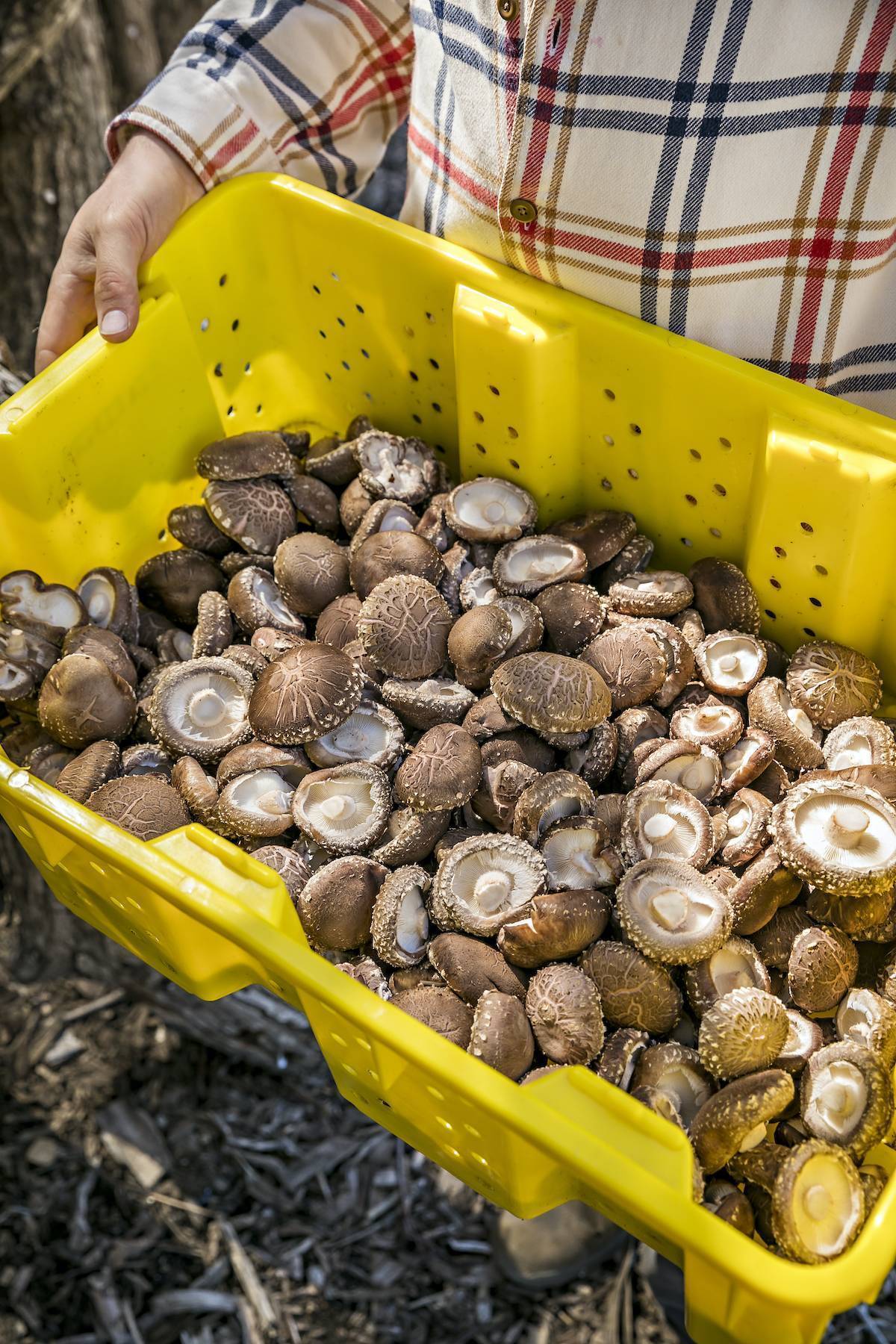


In six days, mushrooms begin bursting through the bark of the oak, ready for harvesting. The crew hand cuts up to 200 pounds a day. They then rotate out those logs to maintain a continuous production May through November. After being used multiple times, the spent logs are left to fully decay back into topsoil. “This constant rotation is significantly more labor intensive than leaving the logs in stacks to fruit on their own,” says Pforzheimer, “but allows for the consistent production that restaurants and consumers need to plan out their dishes and shopping trips.”
This contrasts with today’s commercial mushrooms being grown indoors in vast rooms on sterilized manure, sawdust, or a composted mix of ingredients like corn cobs or cottonseed hulls. Commercial shiitake growers specifically pack sterilized oak sawdust into plastic hulled man-made “logs” placed in environmentally controlled rooms that produce shiitakes in about four months compared to two to four years.
Even still, the Mushroom Council, which represents commercial growers, points to energy savings in growing mushrooms, especially when compared with raising cattle. In “The Mushroom Sustainability Story,” the Council calculated one acre of land can produce one million pounds of mushrooms. Mushroom beds stacked vertically in growing facilities allow a high volume of mushrooms to be grown in relatively small spaces, while using a limited amount of water and a “soil” made of composted materials.
According to Professor Mudge, independent blind taste tests have found forest- or log-grown shiitakes to be superior in flavor, freshness, and nutrition compared to these sawdust-grown shiitake mushrooms commonly found in supermarkets.
MVM works with Island businesses and construction companies to salvage Island oak and cuts limbs into specified four to five-foot lengths. A recent tree-clearing project here in partnership with Mass Heritage restoring a sandplain habitat supplied the farm with three years’ worth of logs.
MVM mushrooms contain double the fiber than those commercially produced and a significant 1/2 gram of protein per cap. That may be less than the concentrated 45-50 grams of protein found in an eight-ounce steak (with 10-16 grams of fat), but Pforzheimer finds “gram for gram, shiitakes are a healthier, more sustainable source.” Shiitakes additionally offer B6, B12, selenium, potassium, zinc, and vitamin D from the sun. Shiitakes are also rich in lentinan, a substance shown in studies to bolster the immune system and aid in fighting cancer. Lentinan also gives the shiitake that woodsy umami — like wild mushrooms — with a hint of garlic.
Chefs love the MVM mushrooms. One told me they’re “the best mushroom product in the country” and another, a top chef in Boston, said “they are the best shiitake mushrooms I’ve ever had.”
As a chef myself, I couldn’t agree more. They are the best mushrooms I have ever tasted, hands down. It’s tough to go back to the commercial store versions; the flavor is bland; I miss that meaty denseness the MVM mushrooms get from feeding on real wood, along with a creamy smoothness characteristic of shiitakes.
On the Island, Chris Stam of Alchemy combined fresh and dried MVM mushrooms for a very popular mushroom Bolognese served last season. The team at Noman’s decided to create a delicious mushroom taco using MVM’s mushrooms as a non-meat option.
“This is extremely gratifying for me since being the center-of-plate protein option is always ideal,” says Pforzheimer. “Our goal is to help people move away from animal protein without feeling they need to compromise on enjoyment.”
Find them at mvmycological.com.